 Skip to main content
Stop pretending that a superior clinical outcome is what closes a $50,000 full-arch case. It isn’t. High-value patients don’t buy titanium and porcelain; they buy biological restoration and the total elimination of social shame. If your office is filled with price-shoppers who treat your expertise like a commodity, your marketing has failed. You are stuck in a race to the bottom because you haven’t mastered high-value dental patient psychology. You know the exhaustion of high lead volume that results in zero actual production. You’re tired of wasting elite chair time on tire-kickers who vanish the moment they see the treatment plan.
It’s time to stop chasing and start dominating. You will learn to command the neurobiology of high-ticket decisions to stop the leak in your sales funnel. We’ll dismantle the weak, generalist marketing strategies that are a death sentence for your practice growth. This guide previews the precise systems needed to engineer predictable lead flow and establish the market authority that makes price irrelevant. Prepare to exit the commodity trap and take your place as the dominant force in your market.
Key Takeaways
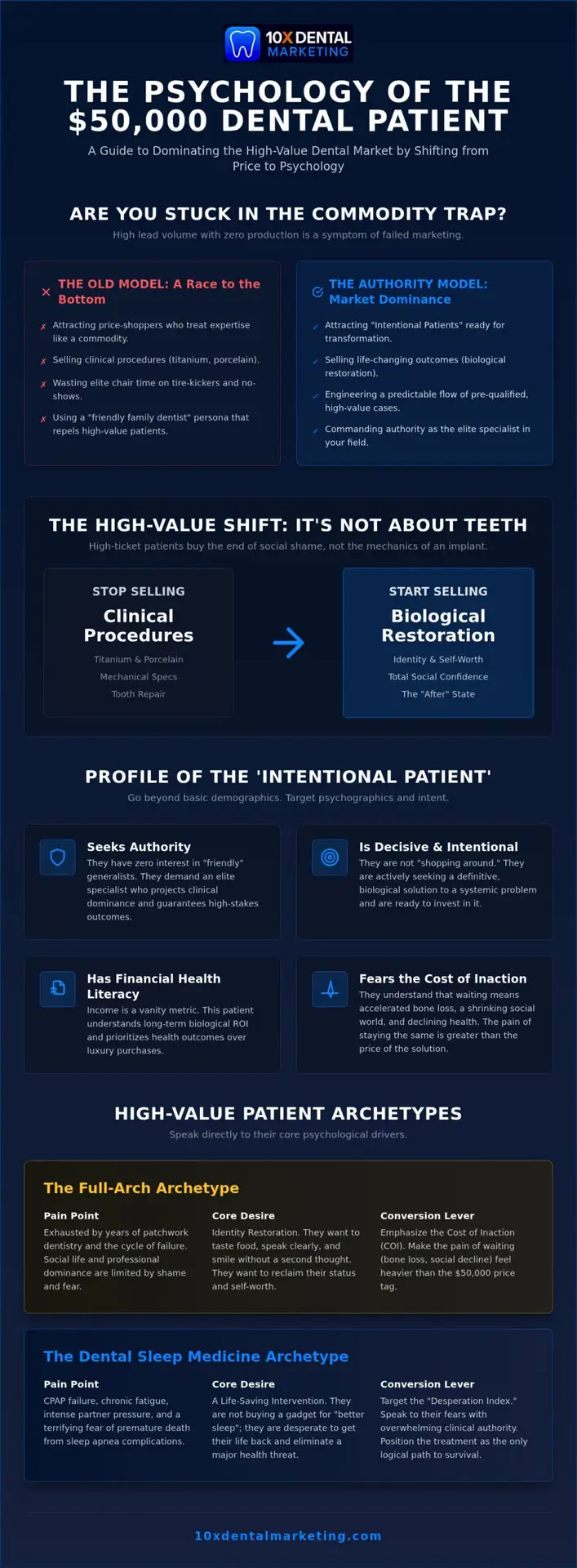
- Stop selling clinical procedures and start selling biological restoration. High-ticket patients buy the end of social shame, not the mechanical specs of an implant.
- Master high-value dental patient psychology to move beyond basic demographics and target the “Intentional Patient” ready for immediate transformation.
- Abandon the “friendly family dentist” persona in favor of clinical dominance. Elite patients demand an authoritative specialist, not a neighborhood friend.
- Leverage medical billing targeting to identify high-readiness leads and use medical insurance coverage to eliminate the $50k price barrier.
- Engineer a relentless lead nurture system that maintains psychological momentum and prevents high-value cases from stalling before the final commitment.
The Neurobiology of the $50,000 Dental Decision
High-value patients operate on a different frequency. They aren’t looking for a “fix.” They are looking for a total transformation. When a patient evaluates a $50,000 treatment plan, they aren’t using the same mental shortcuts they use to buy groceries. They are engaging the prefrontal cortex to analyze long-term biological ROI. If your marketing looks like a commodity, you trigger the brain’s price-sensitivity centers. You become a cost to be minimized rather than a solution to be secured. Understanding the cognitive process of medical decision-making is essential to closing these cases. You must shift the narrative from clinical steps to neurobiological rewards.
High-net-worth individuals have zero interest in “friendly” generalists for complex procedures. They seek the Authority Trigger. They want the elite specialist who dominates the field. Mastery of high-value dental patient psychology requires you to position your practice as the only logical choice for high-stakes outcomes. Generalists sell comfort. Specialists sell results. For these elite cases, results are the only currency that matters. If your brand doesn’t scream clinical dominance, you’ve already lost the lead to a competitor who understands this hierarchy.
Identity Restoration vs. Tooth Repair
Full-arch patients don’t see teeth; they see a barrier to their social life. They see a limitation on their professional dominance. They want to taste food, speak without whistling, and smile without shame. You aren’t selling implants. You are selling the “after” state of total social confidence. You are selling the ability to lead a meeting or attend a gala without fear. Identity Restoration is the psychological process of reclaiming one’s status and self-worth through comprehensive biological reconstruction. This is the core driver of high-value dental patient psychology. When you market to the identity, price becomes secondary to the preservation of the self.
The Cost of Inaction (COI) vs. Price
Price is a distraction. The real enemy is the Cost of Inaction. Every day they wait, bone loss accelerates. Their social world shrinks. Their health declines. Use this reality to bypass the “I need to think about it” defense. The neurochemistry of regret is a powerful conversion tool. It is far more persuasive than a discount. When the pain of staying the same exceeds the pain of the investment, the patient commits. You must make the cost of waiting feel heavier than the $50,000 price tag. Stop defending your price. Start highlighting their loss.
Psychographic Profiling: Beyond Basic Demographics
Income is a vanity metric. Wealth alone does not close a $50,000 case. If you are still targeting “rich people” based on zip codes, you are wasting your marketing budget. High-ticket conversions require intent, not just a high credit limit. You must identify the “Intentional Patient.” These individuals are actively seeking biological solutions to systemic problems. They prioritize health outcomes over luxury purchases. This shift in focus is the foundation of high-value dental patient psychology. You don’t need more leads. You need better filters.
Apply the 80/20 rule to your practice. Twenty percent of your database will drive eighty percent of your high-ticket revenue. Identification of this elite segment requires sophisticated AI to map psychographic traits across national datasets. We look for Financial Health Literacy and a history of decisive medical investments. Stop guessing which patients have the stomach for a major reconstruction. Use data to target those already predisposed to say yes. To dominate your market, you must transition from a passive provider to a proactive hunter of high-intent cases.
Behavior Triggers in Dental Sleep Medicine
Sleep apnea patients aren’t motivated by “better sleep.” They are driven by fatigue, fear of premature death, and intense partner pressure. This is a high-stakes psychological environment. You must position dental sleep medicine marketing as a life-saving intervention. Target the “Desperation Index.” These are patients who have failed CPAP and are terrified of the consequences. They don’t want a gadget; they want their life back. When you speak to this fear with clinical authority, price becomes an afterthought.
The Full-Arch Archetype
The ideal full-arch patient has already “tried everything else.” They’ve spent years on patchwork dentistry and are exhausted by the cycle of failure. They have reached the “Last Resort” stage. This archetype demands a permanent solution and has the psychological readiness to pay for it. You must speak to this exhaustion without sounding desperate for the business. Professional dental brand development creates the necessary specialist authority to anchor this trust. They aren’t looking for a friend; they are looking for the expert who will finally end their dental nightmare. Mastering high-value dental patient psychology means showing them you are that expert before they even walk through your door.
Success in this niche requires a system that identifies these psychological triggers in real time. If your current strategy feels like a commodity, it’s time to engineer a high-performance patient acquisition system that targets intent over demographics.
The Trust-Authority Paradox in High-Ticket Sales
Trust is often a misunderstood currency in the dental industry. Most practitioners believe trust is built through empathy and a “family-friendly” atmosphere. They are wrong. For $50,000 cases, that approach is a liability. High-value patients find “friendly” marketing suspicious. It signals a generalist mindset. These patients aren’t looking for a friend; they are looking for a clinical authority who can execute a complex biological restoration with mechanical precision. This is the cornerstone of high-value dental patient psychology. If your brand feels like a neighborhood commodity, you are begging for price-shoppers and “second opinion” delays. You must shift from a persona of compassion to one of clinical dominance.
The “Pre-Sold” patient is the ultimate goal of any high-ticket system. This happens when your market positioning does the heavy lifting before the patient even enters your office. When you established yourself as the elite specialist, the consultation is no longer a sales pitch. It is a confirmation of expertise. Absolute authority eliminates the competition. It turns the “second opinion” into an unnecessary risk for the patient. You aren’t just another dentist in the directory. You are the superior force in the market. Stop chasing leads and start commanding them through absolute positioning.
Engineering Specialist Authority
Generalists are dying in the age of AI dental lead generation. High-performance systems now identify and filter leads with such precision that the “all-in-one” practice model looks amateur. High-ticket desire is driven by the “Boutique” effect. It thrives on scarcity and exclusivity. Patients who want the best are willing to pay for the best, provided you look the part. You must establish your practice as the national standard for full-arch care. This requires a shift in how you present your clinical results. Don’t show “nice” smiles. Show total biological transformations that other doctors wouldn’t dare attempt.
Digital First Impressions and Subconscious Biases
Your brand has exactly three seconds to pass the subconscious authority test. Does your digital presence scream premium expertise or discount volume? Most dental websites fail this test instantly. They look like generic templates. Professional dental practice brand development creates an immediate psychological lock. It utilizes specific visual cues that signal high-value expertise to the subconscious mind. Use high-octane imagery and aggressive, results-first language. If your brand doesn’t look like it belongs at the top of the market, you will never attract the elite patients who live there. Demand excellence from your brand or accept mediocrity in your production.
Predicting Readiness: Leveraging Medical Billing Data
Amateurs use Facebook interests. Professionals use medical history. Interest targeting is a guessing game that burns through your marketing budget. Medical billing data is a blueprint of intent. By utilizing medical billing targeting dental, you identify patients with pre-existing conditions that make full-arch restoration a biological necessity. These patients aren’t browsing; they are suffering. They have already moved past the “should I?” phase and are stuck on the “how?” phase. This is the most potent filter in the industry.
There is a specific psychological trigger at play here: the “Found Money” effect. When you show a patient that their medical insurance covers a portion of a $50,000 case, the psychological barrier to entry collapses. It isn’t just about the dollar amount. It’s about the validation of the procedure as a medical necessity rather than a cosmetic luxury. This shift is a masterclass in high-value dental patient psychology. Patients with specific medical codes are 10x more likely to convert because the problem is already clinical. You are no longer selling an elective service. You are providing a medical solution.
The Intersection of Health and Finance
We analyze the correlation between systemic health issues and the inevitable need for implants. Bone loss doesn’t stop. Trauma doesn’t reverse. By tracking these medical indicators, you enter the patient’s decision-making cycle months before your competitors even know they exist. Medical data eliminates the price objection by reframing the investment as an essential healthcare requirement. You aren’t selling teeth; you are resolving a chronic medical failure. This precision targeting ensures your chair time is reserved for patients who have both the need and the financial mechanism to move forward immediately.
AI-Driven Intent Mapping
Our machine learning models find patients who are “solution-aware” but “provider-unaware.” They know they need help. They just don’t know you are the elite authority who can provide it. This is high-precision warfare. You scale your practice by ignoring the general population and focusing exclusively on “High-Intent” medical clusters. It is the most efficient path to market dominance. Stop the “spray and pray” amateur approach. Deploy a data-driven acquisition engine that targets readiness with surgical accuracy and leaves your competitors fighting for scraps.
The 10X Patient Journey: Engineering the Close
High-ticket conversions are never accidents. They are engineered outcomes. The path from a “Distressed Searcher” to a “Committed Patient” is a high-speed psychological transition. If your response time is slow, you’ve already lost the case. The first five minutes after a lead is generated determine the $50,000 outcome. This is the “Speed to Lead” principle in action. In this narrow window, the patient’s emotional state is at its peak. Delaying your response allows doubt to set in. It allows competitors to intervene. Mastering high-value dental patient psychology means capturing that momentum before it dissipates into hesitation.
Maintaining that momentum requires a relentless Lead Nurture Machine. You don’t rely on manual follow-ups from a distracted front desk. You deploy an automated system that reinforces your authority at every touchpoint. This isn’t about “staying in touch.” It’s about psychological conditioning. Every message must dismantle a specific objection. Every video must showcase a successful biological transformation. To elevate your practice’s visual storytelling, you can learn more about SN Media Services LLC and their professional video production. The 10X method closes the gap between interest and investment by keeping the patient locked in your ecosystem. If they stop hearing from you, they start looking elsewhere.
Eliminating Friction in the Decision Funnel
Identify the “Psychological Choke Points” where high-value patients typically drop off. These are the moments where the weight of the investment causes a fight-or-flight response. You must dissolve these final objections with surgical precision. Use social proof and case studies that mirror their specific medical history to normalize the decision. To learn more about how Advocators leverages AI-powered advocacy to transform these success stories into authoritative market signals, consider the impact of authentic messengers. The “Consultation Blueprint” is the final stage of high-value dental patient psychology. It moves the patient from a clinical exam to a financial commitment without friction. You aren’t asking for a sale. You are presenting the only viable solution to their biological crisis.
Stop competing. Start dominating. If you are still fighting for scraps in the generalist market, your system is fundamentally broken. Specialized, data-driven full arch implant marketing is the only way to ensure elite ROI in 2026. The market for high-ticket cases is consolidating. Patients are gravitating toward authoritative specialists who command the field. You must choose your path. Step up to elite performance or accept the slow decline of average results. The 10X strategy is the engine for those obsessed with winning. Use it to seize the market leadership you deserve.
Command the Market or Become a Commodity
Mediocrity is a choice. You now understand the neurobiological triggers of the $50,000 decision. You’ve seen how medical billing data acts as a psychological filter to eliminate tire-kickers. Generalist marketing is a death sentence for high-ticket growth. To win, you must dominate the high-value dental patient psychology that drives elite cases. Stop settling for low-intent leads and price-shoppers who waste your chair time. It’s time to deploy a system that commands authority and secures commitment before the patient even enters your office.
The 10X system is built for practitioners who refuse to lose. We combine DSO-level executive leadership with proprietary AI-driven lead generation. We are the undisputed specialists in $50k+ full-arch cases. Anything less than our mechanical precision is a path to average results. Your market is consolidating. Either take control of the acquisition engine or watch your competitors seize the lead. The opportunity for dominance is here. Take it.
Stop chasing tire-kickers and start dominating with 10X Dental Marketing. Step up to elite performance and watch your practice thrive.
Frequently Asked Questions
Why do high-value dental patients care more about authority than price?
Authority is the ultimate insurance policy for elite patients. High-value dental patient psychology dictates that these individuals prioritize clinical dominance over a discount. They don’t want a “fair deal.” They want a guaranteed result. If you look like a commodity, they will treat you like one. Positioning yourself as the authoritative specialist removes the risk of failure in their mind. This makes the $50,000 price tag secondary to the preservation of their health.
How does medical billing data help in targeting implant patients?
Medical billing data identifies patients with specific clinical histories that make them 10x more likely to convert. We target patients with pre-existing conditions like advanced bone loss or systemic dental failure. This strategy reframes the procedure as a medical necessity. It introduces the “Found Money” effect by leveraging medical insurance to lower the financial barrier. This data-driven precision ensures you stop chasing tire-kickers and start speaking to patients biologically ready for transformation.
What is the difference between psychographics and demographics in dental marketing?
Demographics tell you where a patient lives and what they earn. Psychographics tell you why they buy. Demographics are surface-level data. Psychographics reveal the underlying intent, social shame, and desire for restoration. Mastering high-value dental patient psychology requires moving beyond income brackets. You must target the “Intentional Patient” who values biological ROI over short-term savings. Demographics find people with money. Psychographics find people who are ready to spend it on your expertise.
Can AI really predict which patients will spend $50,000 on implants?
AI analyzes millions of data points to identify high-intent clusters with mechanical precision. It maps medical history, financial literacy, and decisive investment patterns to predict readiness. The machine doesn’t guess. It finds “solution-aware” patients who are currently provider-unaware. This allows you to scale your practice by focusing only on clusters with the highest probability of closing $50,000 cases. It is the difference between a spray-and-pray amateur approach and surgical market dominance.
Why do general dental marketing strategies fail for full-arch cases?
Generalist strategies fail because they try to appeal to everyone. High-ticket cases require a specialist authority that generalist marketing cannot provide. When you focus on being “friendly” or “affordable,” you trigger the brain’s price-sensitivity centers. You become a cost to be minimized. Elite patients are suspicious of generalists for complex reconstructions. They seek the specialist who dominates the niche. If your marketing feels like a commodity, you will never close a $50,000 case.
How can I build practice authority fast in a competitive national market?
Rapid authority building requires a total abandonment of the “neighborhood dentist” persona. You must establish a national brand that screams clinical dominance. Use high-octane visual cues and results-first language to signal expertise to the subconscious mind. Showcase total biological restorations rather than simple smile makeovers. Scarcity and exclusivity drive desire in high-ticket markets. Position your practice as the only logical choice for high-stakes outcomes to eliminate the competition before the first consult.
What psychological triggers are most effective for sleep apnea patients?
Sleep apnea patients are driven by intense fatigue and the fear of premature death. Partner pressure is also a massive psychological catalyst. You must position your outreach as a life-saving intervention. Target patients who have failed CPAP and are stuck in the “Desperation Index.” They aren’t looking for a gadget. They want their life back. When you speak to these survival triggers with clinical authority, the financial barrier to entry effectively disappears.
Is it possible to automate the nurturing of high-ticket dental leads?
Automation is essential to maintaining psychological momentum after a lead is generated. A Lead Nurture Machine ensures no high-value case stalls due to neglect. It delivers a sequence of authority-building content that dismantles objections in real time. This system keeps the patient locked in your ecosystem until they reach the point of commitment. You don’t leave your $50,000 outcomes to a distracted front desk. You use a sophisticated system to ensure total conversion and market leadership.
