AI lead generation for dental practices can help attract and follow up with qualified prospects. But before a campaign goes live, it’s important to know what data it uses and where that information goes. When data sources, access, and handling are unclear, growth can come at the expense of trust.
A workflow might use information from public marketing interactions, or it might connect with systems containing sensitive patient information. The difference matters. Before choosing a provider, get clear answers about what data is collected, where it goes, who can access it, and how long it’s retained. AI claims alone aren’t proof of a safe, effective process.
This article explains how to evaluate and implement AI lead generation with data governance built in. You’ll learn how to map data flows, assess providers with practical privacy and security questions, and set measurable goals with clear ownership and human oversight. The result is a more transparent path from qualified inquiries to follow-up, with patient trust in view.
Key Takeaways
- Map the information each campaign collects, uses, and shares so you can distinguish general marketing data from details that may identify a patient or reveal care.
- Evaluate whether privacy and security risks depend on the specific entities, services, data, and workflow, then seek qualified legal guidance where needed.
- Use a practical scorecard to compare manual campaigns, general-purpose AI tools, and specialized dental providers on data sources, access, retention, documentation, and reporting.
- Put AI lead generation for dental practices through defined stages: set the campaign purpose, map data, review providers, test the workflow, and monitor results.
- Choose a partner that can explain and document its process, while keeping responsibilities clear across your practice, the provider, and any platforms involved.
AI lead generation for dental practices: what data moves through the process?
AI lead generation uses data and automation to identify, reach, and qualify potential patients. A campaign may rely on broad audience characteristics and interactions with an advertisement, or it may connect with information that can identify a person or reveal details about care. Don’t assume every AI campaign uses patient records. Map the actual workflow before deciding what safeguards it needs.
AI lead generation is a marketing workflow that uses data and automation to attract and qualify potential dental prospects, and it does not automatically require patient records. The goal is to turn interest into an inquiry the practice can follow up on, not to make a clinical judgment. A lead is a marketing inquiry, not a diagnosis, treatment recommendation, or confirmed patient. For a neutral overview of the underlying process, see Lead generation.
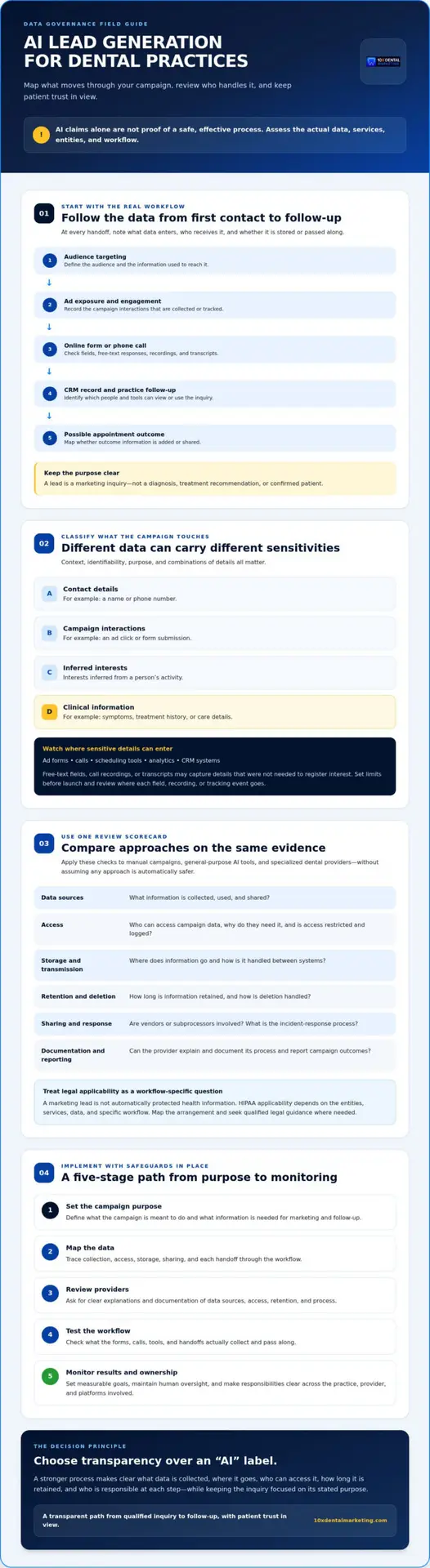
Trace the journey from audience targeting to ad exposure and engagement, then through an online form or phone call, a CRM record, practice follow-up, and possibly an appointment outcome. Each handoff can add information or send it to another tool. For every step, note what data enters, who receives it, and whether it is stored or passed along. That map shows what the campaign actually uses.
Which data can an AI dental campaign use?
Separate inputs into categories: contact details such as a name or phone number; campaign interactions such as an ad click or form submission; inferred interests based on a person’s activity; and clinical information, such as symptoms, treatment history, or care details. Sensitivity depends on context, identifiability, purpose, and how separate details are combined. Data that seems general on its own may become more revealing when linked to a person or a specific service inquiry.
Medical billing targeting is a distinct data source, not just another advertising signal. Before using it, document what information is involved, where it comes from, how it will be used, and who can access it. Don’t assume the label “marketing data” settles the privacy question.
Where can sensitive information enter the lead funnel?
Information can enter through ad forms, calls, scheduling tools, analytics, and CRM systems. Free-text boxes may invite people to describe symptoms or treatment concerns. Call recordings or transcripts may capture details that weren’t needed to register interest. From there, information may pass to additional platforms or people involved in follow-up.
Set limits before launch. Ask only for details needed for the stated marketing and follow-up purpose, and review where each field, recording, or tracking event goes. A focused inquiry form can ask for contact preferences and the service a person wants information about without inviting a medical history. Clear boundaries help protect a prospect’s trust and keep the form focused on its purpose.
How to assess privacy and security risks in AI dental lead generation
AI doesn’t make a workflow automatically safe or unsafe. Risk depends on the information involved, who handles it, and what each tool does with it. For AI lead generation for dental practices, assess the real data flow, not a vendor’s use of the word “AI” or a broad privacy label.
A marketing lead is not automatically protected health information; whether information qualifies depends on the data, its context, and how it is handled. Treat that as a question for qualified counsel, not a shortcut for classifying every campaign inquiry. HIPAA applicability depends on the entities, services, data, and specific workflow. Map those details and ask counsel to assess the actual arrangement.
Use a structured review. The voluntary NIST AI Risk Management Framework offers a way to organize AI risk assessment, but it doesn’t replace legal advice or prove a vendor meets your requirements. Focus on practical controls: who can access campaign data, why they need access, how access is restricted, and whether it’s logged. Then examine storage and transmission, retention and deletion, incident response, and any sharing with vendors or subprocessors.
What should a dental practice verify about HIPAA and vendors?
Identify the practice’s role and each vendor’s role at every step, from collecting an inquiry to reporting campaign outcomes. Ask what information each party receives, what service it performs, and whether it passes data onward. Have qualified counsel determine whether a business associate agreement is required for the specific relationship. Request current written descriptions of safeguards and data practices. A vendor’s label or assurance isn’t proof of compliance.
How can teams reduce unnecessary exposure?
Start with less data. Limit forms to fields needed for the stated marketing and follow-up purpose, and avoid inviting clinical details into advertising forms. Set role-based access so staff and vendors see only what they need. Require secure authentication and document how access is removed when a person’s role changes or ends.
Put retention and deletion rules in writing. Confirm how they apply across connected tools, vendors, and subprocessors, including copies used for reporting or stored in call systems. Ask who handles a suspected incident, how it is escalated, and what records will be available for review. Look for answers that address your workflow, not generic promises.
When evaluating a specialized provider, compare its documented targeting and data-handling process with your practice’s requirements. Explore AI-driven lead generation as one option, then verify the data sources, roles, safeguards, and agreements relevant to your campaign before moving forward.
Compare AI dental lead-generation approaches with a data-security scorecard
Choose a workflow you can inspect, not one that simply sounds advanced. Manual campaigns, general-purpose AI tools, and specialized dental lead-generation providers can involve different data sources and systems. None is automatically the safest choice. Score the documented process, including the tools behind it, before activation.
Use this scorecard to compare options. Rate each area from 0 to 2: 0 means no evidence provided, 1 means the explanation is partial, and 2 means current documentation answers the question. Give points for specific evidence, not broad assurances.
| Review area | Manual campaigns | General-purpose AI tools | Specialized dental provider |
|---|---|---|---|
| Data sources | List information used across staff and campaign tools. | Identify each input, its origin, and whether it enters prompts. | Document campaign sources, including medical billing targeting. |
| Collection limits | Check forms and staff processes for unnecessary fields. | Confirm what users can enter and what the tool retains. | Review how inquiries are collected and qualified. |
| Access | Identify who can see records across systems. | Ask who can access inputs and outputs, and how access is restricted. | Request access roles, logging details, and account-removal steps. |
| Retention | Set and verify deletion practices for each tool. | Confirm storage, retention, and deletion terms. | Document retention rules across the provider and subprocessors. |
| Documentation | Record staff procedures and vendor arrangements. | Request written data-use and safeguard descriptions. | Review data-flow, vendor, and campaign documentation. |
| Reporting | Agree on how inquiry and follow-up are tracked. | Check whether outputs can be audited and understood. | Confirm how campaign results connect to practice follow-up. |
Manual processes still depend on the systems staff use. With general-purpose tools, scrutinize what data is entered and how the tool handles it. A specialized dental provider may understand campaign context, but specialization alone doesn’t prove suitable safeguards. For medical billing targeting, require a clear explanation of sourcing, governance, and review before launch.
Questions to ask before selecting an AI lead-generation provider
Ask what data enters the workflow, where it comes from, and whether it is identifiable or sensitive. Request documentation on access controls, retention, deletion, incident response, and subprocessors. Confirm that your practice can review campaign settings and understand how inquiries are qualified. If answers are vague, pause the evaluation.
How to score transparency, control, and performance
Agree on definitions for qualified inquiries, contact rates, appointments, and treatment outcomes. Assign an owner to each metric, data source, approval, and escalation path. Campaign attribution can show how an inquiry progresses to an appointment, but keep marketing reporting distinct from clinical records. This gives the practice a useful performance view without treating lead data as a substitute for care documentation.
For a broader look at campaign strategy, review AI dental lead generation strategy, then assess any provider against your documented data-governance requirements.
How to implement AI lead generation with safeguards in place
Build the workflow in stages. AI lead generation for dental practices should have a defined purpose, a controlled data path, and a named practice owner before it goes live. That structure makes it easier to catch gaps early and connect campaign activity to useful outcomes while keeping data responsibilities clear.
- Define: Set the campaign goal, target audience, permitted data inputs, and accountable practice owner.
- Map: Trace each field through forms, platforms, vendors, calls, and follow-up systems.
- Review: Examine vendor roles, safeguards, agreements, and any platform requirements with qualified experts.
- Test: Use dummy records to check forms, routing, access, and reporting before launch. Never test with real patient information.
- Monitor and improve: Review performance and controls on a set schedule, document changes, and correct issues before they spread.
Before launch: define the data boundary
Make a working inventory of every system, vendor, form field, transfer, and person involved in the lead journey. Remove fields that aren’t necessary, and give staff clear instructions for handling unsolicited clinical details, including where not to copy or forward them. Ask qualified counsel and security professionals to review the specific data flow, agreements, and applicable legal or platform requirements. Don’t rely on assumptions.
Record the decisions: who approved the campaign, who has access, how long information is retained, how access is removed, and whom to contact if something goes wrong. Assign an owner to update the documentation when a tool, vendor, or campaign setting changes.
After launch: monitor quality and control
Set a regular review cadence. Check access logs where available, lead-routing errors, unexpected data collection, and vendor or subprocessor changes. Track qualified inquiries and conversion using approved, minimized reporting fields, with clear definitions and an owner for each metric. If you suspect information has been exposed, pause the affected workflow and escalate through the practice’s documented response process. Don’t investigate by sharing more sensitive information through unapproved channels.
Strong implementation is deliberate: define the boundary, test the handoffs, then monitor results and controls. To discuss AI-driven lead generation for your practice, evaluate the provider’s documented process against your requirements before moving forward.
Choose a dental AI lead-generation partner that can prove its process
Choose on evidence, not polished claims. A strong partner should explain its dental campaign workflow, document how data is handled, and show how results are measured. Dental specialization can help with campaign context, but it doesn’t establish that a provider’s security practices meet your requirements. Verify the actual process.
Keep responsibilities distinct. An agency can describe the campaign and its role in the workflow. Your practice remains responsible for decisions within its operations, while platforms have their own data practices and terms. Qualified counsel can advise on legal obligations; a marketing provider isn’t a substitute for independent legal advice. For AI lead generation for dental practices, clarity across these roles is essential.
What evidence should a provider show before engagement?
Request a workflow diagram, data inventory, vendor and subprocessor list, and written description of who does what. Ask where campaign information originates, which systems receive it, and what happens to it after use. Request evidence supporting any security claims, then have qualified counsel or security staff review the relevant documents. Check that reporting connects qualified inquiries to appointments without unnecessary clinical detail.
Ask for clear definitions, too. What counts as a qualified inquiry? Which party records contact attempts and appointment outcomes? How are data-source changes reviewed? For medical billing targeting, ask how the data is sourced, governed, and reviewed before activation. You can also examine the provider’s medical billing targeting for dental practices as part of that evaluation, without treating a service description as proof of specific safeguards.
Turn evaluation into a controlled first campaign
Start with one defined service line, limited data inputs, and an agreed baseline for lead quality. Before launch, document the reporting fields, review dates, escalation contacts, and conditions that would pause the campaign. Assign an owner on the practice side to review performance and raise questions when the workflow changes. A focused start makes it easier to assess results and data handling before expanding.
10X Dental Marketing offers AI-driven lead generation and medical billing targeting for dental practices. Verify the specific data sources, processing roles, retention practices, safeguards, and vendor relationships for the proposed campaign. Discuss your campaign goals and required data safeguards before deciding whether the approach fits your practice.
Build growth on a workflow you can trust
AI lead generation for dental practices works best when campaign performance and data stewardship move together. Know what information enters the workflow, document who is responsible at each step, and measure progress from qualified inquiry through practice follow-up. A clear process supports better decisions and helps protect the trust that patient relationships depend on.
Choose a partner by asking for evidence, not relying on broad claims. 10X Dental Marketing offers AI-driven lead generation and specializes in full-arch implant marketing and dental sleep medicine. Its leadership team brings experience with nationally recognized Dental Support Organizations. As with any provider, review the proposed campaign’s data sources, responsibilities, and safeguards against your practice’s requirements.
Ready to define your goals and the safeguards your campaign needs? Discuss an AI lead-generation strategy for your practice. With clear ownership and a measured approach, your practice can pursue growth with confidence.
Frequently Asked Questions
Is AI lead generation safe for dental practices?
It can be used responsibly, but AI alone doesn’t make a campaign safe. Risk depends on the data collected, the systems and vendors involved, who can access information, and how it’s stored, shared, and deleted. Map the workflow before launch, minimize data collection, and ask vendors for written details about their practices. Have qualified counsel and security professionals review the specific setup, especially if sensitive information may be involved.
Can dental practices use AI without sharing protected health information?
Yes. A practice can design a campaign around limited marketing information, such as contact details and campaign interactions, rather than clinical records. Use forms that request only what’s needed to respond to an inquiry, and don’t invite people to enter medical histories or treatment details. Check every connected tool and transfer, since sensitive information can enter through free-text fields, calls, or scheduling workflows even when the campaign wasn’t designed to use it.
How should a dental practice evaluate an AI lead-generation vendor?
Ask the vendor to document its data sources, workflow, access practices, retention and deletion approach, incident response, and any vendors or subprocessors involved. Confirm who does what, how inquiries are qualified, and whether your practice can review campaign settings and reporting. Request evidence for security claims instead of relying on labels or verbal assurances. Then have qualified counsel or security staff assess the documents against your practice’s needs and the proposed workflow.
Does HIPAA apply to AI dental marketing?
It may, depending on the entities, services, information, and specific workflow. Using AI doesn’t create an exemption from applicable privacy requirements. Determine whether protected health information enters the tool or is created, received, maintained, or transmitted through it. Ask qualified counsel to assess the arrangement and whether a business associate agreement is required. Don’t assume a campaign is outside HIPAA just because it’s described as marketing or uses a third-party AI tool.
What happens if a patient enters medical details into a lead form?
First, follow the practice’s documented process for handling unsolicited sensitive information. Limit access, avoid copying it into additional marketing tools, and route it only through approved channels for review by the appropriate staff. Assess which systems received the details and whether any vendor or platform also accessed them. If the information may have been exposed or mishandled, escalate through the practice’s response process and consult qualified counsel about next steps.
Can medical billing data be used for dental lead generation?
Medical billing targeting is used in dental marketing, but the data source and proposed use need documented review before a campaign begins. Ask what information is involved, where it originates, how it’s governed, which parties can access it, and whether it may reveal sensitive details. Don’t assume a data source is appropriate simply because it can identify a potential audience. Have qualified counsel review the specific use, relationships, and any applicable agreements.
How can a practice tell whether AI-generated dental leads are qualified?
Define “qualified” before judging campaign performance. Agree on criteria such as whether the inquiry relates to the promoted service, includes usable contact information, and can be followed up by the practice. Track the progression from inquiry to contact and appointment using consistent definitions, then review outcomes with the campaign provider. Keep marketing attribution separate from clinical records, and use only the reporting fields needed to assess lead quality and follow-up.