 Skip to main content
The standard 5% marketing budget is a death sentence for growth-minded clinicians. It’s a relic of an era when local referrals were enough to keep the lights on. If you’re asking how much should a dental practice spend on marketing in 2026, you’re likely tired of seeing your overhead climb while your high-ticket case volume stays flat. Generalist agencies have failed you. They trade your hard-earned capital for vanity metrics and low-quality leads that never convert. You don’t need “awareness.” You need a machine.
We know the frustration of stagnant revenue and a schedule filled with tire-kickers. It’s time to stop guessing and start dominating. This guide reveals the exact math required to scale full-arch implants and dental sleep medicine through precision-engineered systems. We’ll break down the shift from maintenance spending to aggressive market leadership. You’ll learn how to calculate your patient acquisition cost and deploy AI-driven strategies that ensure total market dominance. The era of the amateur is over. It’s time to win.
Key Takeaways
- Shatter the 5% myth and learn why traditional budgeting methods lead to mediocre patient flow and wasted overhead in a saturated market.
- Calculate the precise investment levels required for how much should a dental practice spend on marketing to transition from survival to total market dominance.
- Unlock the high-ticket math needed to predictably scale $50k+ full-arch cases and high-margin dental sleep medicine procedures.
- Deploy AI-driven lead generation and medical billing targeting to eliminate “tire-kickers” and capture patients with high financial intent.
- Transform your marketing from a static cost center into a precision-engineered profit machine that builds absolute brand authority.
Beyond the 5% Myth: Why Most Dental Marketing Budgets Fail
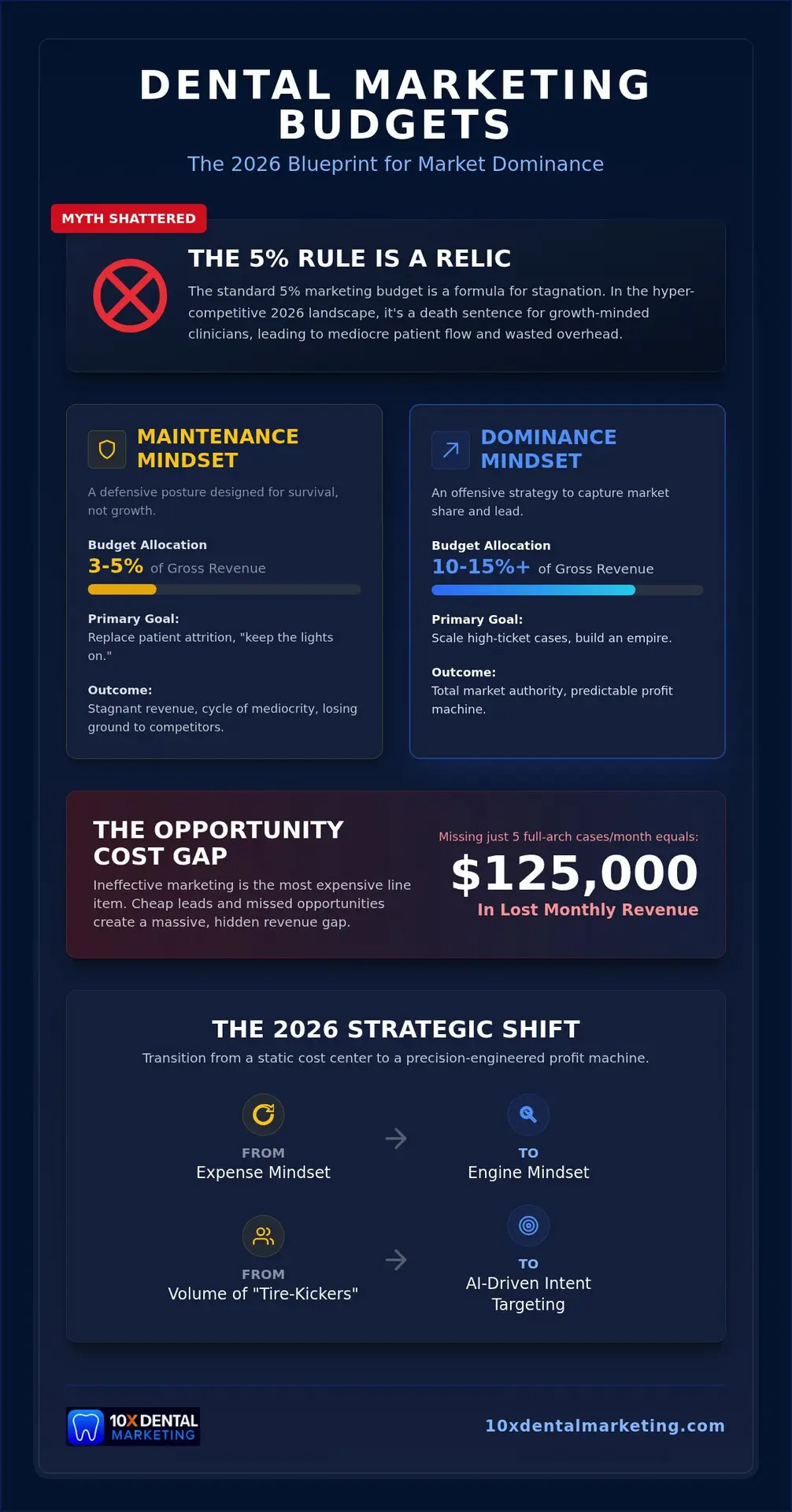
The 5% rule is a relic. It is a formula for stagnation. In the hyper-competitive 2026 landscape, reinvesting only 5% of your gross revenue is a recipe for mediocrity. It’s enough to keep your name in the hat, but it’s never enough to win the game. Most clinicians ask how much should a dental practice spend on marketing while looking for the lowest possible number. This is the wrong starting point. If your goal is to dominate your market and capture high-ticket cases, you must stop thinking like a bookkeeper and start thinking like a predator.
Most clinicians fall into the Marketing Trap. They spend just enough to exist, but not enough to scale. This creates a cycle of “maintenance” where you replace lost patients but never actually grow. Generalist agencies prefer these generic, low-risk budgets. They want your monthly management fee without the accountability of producing $50k full-arch cases. They can’t handle the complexity of high-ticket acquisition. They sell you “impressions” when you need signed contracts. A basic marketing spending overview illustrates the gap between fixed operational costs and the variable investments required for aggressive growth.
Stop viewing marketing as a line-item expense on your P&L. It’s an engine. In an expense mindset, you try to cut costs to save money. In an engine mindset, you add fuel to go faster. When calculating how much should a dental practice spend on marketing, you must decide if you are funding a hobby or a high-performance machine. Precision-engineered marketing doesn’t cost money; it generates it. Anything else is just a donation to Google.
The Cost of Ineffective Marketing
The 2026 Competitive Landscape
Consolidation by DSOs has permanently raised the barrier to entry for independent practices. These entities have massive, centralized budgets and sophisticated acquisition machines. Relying on “word of mouth” is a slow death sentence. It is too slow to counter the aggressive digital land grab happening right now. You must shift from volume-based marketing to intent-based acquisition. Winning in 2026 requires targeting patients who aren’t just looking for a dentist, but are actively seeking a specific, high-value solution. Move fast or get left behind.
Maintenance vs. Dominance: Two Ways to Fund Your Growth
You must decide if you want to exist or if you want to lead. A maintenance budget, typically 3-5% of gross revenue, is designed for the status quo. It replaces the natural attrition of patients who move or leave. It keeps the lights on. It does not build an empire. If you are asking how much should a dental practice spend on marketing simply to stay level, you are already losing ground to the aggressive players moving into your territory. Maintenance is a defensive posture. Dominance is an offensive strategy.
Dominance requires a different math. A dominance budget sits between 10% and 15% of revenue, or higher for those scaling high-ticket procedures like full-arch implants. This is about capturing market share. It is about outspending and out-thinking the competition until you reach the Dominance Threshold. This is the point where your brand becomes so ubiquitous that competitors must spend double just to get noticed. Startups must over-invest in years one and two. You cannot “save” your way to authority. You must buy it.
Calculating Your Growth Multiple
Stop setting budgets based on last year’s performance. Set them based on next year’s goals. If you want to add $1 million in new revenue, you must calculate the patient acquisition cost (PAC) for that specific volume. The 10X Blueprint focuses on reinvesting profits into high-intent lead generation. By utilizing medical billing targeting for dental, you can identify patients with the highest financial intent and clinical need. This surgical approach increases your growth multiple. It ensures every dollar spent targets a high-margin outcome rather than a generic cleaning.
The DSO Advantage: How the Big Players Spend
Nationally recognized DSOs do not guess. They operate with institutional capital and executive teams that treat patient acquisition like a commodity trade. They buy the top of the search results through sheer force of spend. They are the machine. To compete, independent practices cannot rely on the same amateur tactics used by generalist agencies. You need to scale your high-ticket case volume with precision-engineered systems that the big players are too slow to implement. While they use blunt force, you must use data-driven surgical strikes. Win through intelligence, not just volume.
The High-Ticket Math: Budgeting for Full-Arch Implants and Sleep Medicine
General dentistry is a volume game. High-ticket procedures are a precision game. When you analyze how much should a dental practice spend on marketing, you must separate your budget into two distinct buckets: general maintenance and high-ticket acquisition. You cannot hunt whales with a net designed for minnows. Full-arch implants and dental sleep medicine require a significantly higher patient acquisition cost (PAC). The return on investment (ROI) is massive. If you use a flat percentage for both, you’re starving your most profitable services. You’re denying them the fuel required to scale. Calculating how much should a dental practice spend on marketing for these specialized niches requires understanding that you are competing for a limited pool of elite patients. Quality always beats quantity. Stop buying broad keywords. Start buying results.
Full-Arch Acquisition Costs
A single full-arch case can generate $50,000 in revenue. Many clinicians hesitate to spend $2,000 to acquire that patient. This is illogical. A $2,000 PAC for a $50,000 case represents a 25:1 return. That is an elite bargain. Generalist agencies focus on “cheap” leads for cleanings or exams. These leads cost $50 but offer low lifetime value. Consider the contrast in lead quality:
- General Cleaning Lead: Low cost, low immediate revenue, high front-desk labor.
- Full-Arch Lead: Higher acquisition cost, massive revenue, high clinical priority.
These high-value cases require more investment because you are targeting the “Invisible Patient.” These are individuals who have stopped looking for a traditional dentist. They want a total life transformation. Our full arch implant marketing strategies utilize medical insurance dental implant marketing to find these high-intent individuals. We find them where others cannot. We find them before they settle for a cheaper, inferior alternative.
Sleep Medicine: The Recurring Revenue Powerhouse
Dental sleep medicine is a hidden revenue engine. Most practices ignore it. Unlike a one-off implant, sleep apnea patients represent massive long-term patient value (LTV). They are a gateway to medical billing. You aren’t just selling a device. You are selling life-saving oxygen. This requires a specific educational funnel. You cannot run a generic ad for sleep apnea. It takes a sophisticated system to move a patient from awareness to consultation.
Budgeting for this means investing in AI-driven targeting. This identifies intent before the patient even knows they have a problem. You must fund the education of your market to own it. Review our dental sleep medicine marketing tactics to see how we engineer this high-ticket dominance. Stop guessing. Start winning. Control the narrative and the revenue will follow.
Precision Over Luck: Leveraging AI and Medical Billing in Your 2026 Budget
Luck is not a strategy. It’s a liability. In 2026, the question of how much should a dental practice spend on marketing is answered by data, not intuition. You must stop buying broad keywords that attract price shoppers and tire-kickers. Start targeting medical billing triggers that signal clinical urgency. Deploy AI to identify patients with both high intent and the financial means to pay for high-ticket procedures. This allows you to shift your budget from generic “awareness” to aggressive “conversion” at the exact point of need. Use predictive analytics to forecast your quarterly ROI with mechanical precision. If you can’t predict the outcome, you shouldn’t spend the dollar.
The transition to a precision-engineered budget follows four non-negotiable steps:
- Step 1: Abandon broad-match keywords. Replace them with triggers based on medical billing data and systemic health indicators.
- Step 2: Integrate AI filters to qualify leads based on creditworthiness and procedural intent before they enter your CRM.
- Step 3: Reallocate capital toward high-intent conversion funnels. Stop paying for eyeballs; start paying for booked consultations.
- Step 4: Implement predictive modeling. Use your current data to determine exactly how much fuel the machine needs to hit your revenue targets next quarter.
The Machine vs. The Amateur
Manual bid management is dead. Humans are too slow. They are too emotional. They lack the capacity to process the thousands of variables required to win in a saturated market. High-performance AI dental lead generation identifies patterns that an amateur agency will never see. It reduces wasted ad spend by cutting off low-intent traffic before it drains your budget. The machine optimizes in real-time. It learns from every interaction. It wins because it never sleeps. When you use the machine, your budget stops being a gamble and starts being an inevitability.
Medical Billing Targeting: The Unfair Advantage
Your competitors are fighting for scraps on Google. They are obsessed with “Dental SEO” and organic reach. While they wait for the algorithm to notice them, you should own the data. Medical billing targeting allows you to access patients who have already been flagged for dental needs within the medical system. This is the ultimate signal of intent. By targeting patients with documented medical necessity, you can reduce your PAC by 30-50% while increasing your case acceptance. This precision data eliminates the guesswork of how much should a dental practice spend on marketing. It puts you in front of the patient before they even think to search for a provider.
Stop wasting capital on agencies that guess. Deploy our precision-engineered lead generation machine and own your market with total authority.
Scaling to 10X: How to Turn Your Marketing Budget into a Revenue Engine
Marketing isn’t an expense. It’s a profit machine. Amateurs see a monthly bill; leaders see a high-performance engine. If your budget feels like a burden, you’re doing it wrong. You’re likely stuck with a generalist agency that doesn’t understand high-ticket math. The 10X Method isn’t about incremental, 2% gains. It’s about total market capture. It’s about reinvesting profits to trigger exponential growth. When you finally master the logic of how much should a dental practice spend on marketing, you stop fearing the spend. You start craving the scale. You stop looking for ways to cut costs and start looking for ways to add fuel.
Engineering Specialist Authority
Price is only an issue in the absence of value. To command premium fees for $50k full-arch cases, you must move beyond the “neighborhood dentist” persona. You need absolute authority. This requires sophisticated dental practice brand development. You must position your practice as the only logical choice for complex, high-stakes procedures. This is a psychological shift. You’re no longer selling dentistry. You’re selling a total life transformation. When your brand reaches this level, price becomes irrelevant. You aren’t competing with the clinic down the street. You’re in a category of one. You own the mindshare, so you own the market.
The Final Verdict on Spend
The era of guessing is over. You’ve seen the math. You understand the “Dominance Threshold.” Now, you must act. Stop asking “how much should I spend?” and start asking “how fast can I scale?” If you can put $1 in and get $10 out, your budget should be infinite. This is the 10X Dental Marketing standard. We don’t provide “services.” We provide an unfair advantage. We use proprietary medical billing data and AI-driven precision to ensure your capital is never wasted. We eliminate the “tire-kickers” and deliver the high-intent patients your practice deserves.
Your current agency is likely comfortable. They want your monthly fee while you take all the risk. Demand a higher level of performance. Demand a system that produces high-ticket case closures with mechanical predictability. The market is consolidating. The big players are moving. You can either be the one being bought or the one doing the buying. The question of how much should a dental practice spend on marketing is ultimately a question of how much you value your future. Secure your market dominance with 10X Dental Marketing. The machine is ready. Are you?
Dominate Your Market or Get Left Behind
The 5% maintenance budget is a relic of an amateur past. It is a death sentence for growth. If you are still asking how much should a dental practice spend on marketing while looking for the lowest possible number, you have already lost. Real growth requires a high-performance engine mindset. You must fund dominance. By leveraging AI-driven lead generation and proprietary medical billing data, we strip away the guesswork that plagues generalist agencies. We replace generic, low-intent traffic with surgical precision.
Our executive team brings deep DSO experience to the independent practice level. We do not guess. We engineer success with mechanical predictability. You have seen the high-ticket math behind $50k case closures. You understand the power of medical billing targeting. Now, you must choose your path. You can keep donating capital to agencies that fail; or you can deploy a system designed to win. The machine is ready to scale your high-ticket patient flow.
Stop wasting your budget and start dominating your market with the 10X Blueprint. Your market is waiting for a leader. It’s time to take control of your revenue and command the authority you deserve. Step up to the elite level today.
Frequently Asked Questions
Is a 5% marketing budget enough for a dental practice in 2026?
A 5% budget is a recipe for stagnation, not a strategy for growth. While established practices might survive on a 5-10% reinvestment, anyone asking how much should a dental practice spend on marketing to dominate needs to target the 10-15% range. This aggressive funding builds the machine required to outpace DSOs and local competitors. Spending too little isn’t saving money; it’s surrendering your market share to those willing to play at a higher level.
How much should a startup dental practice spend on marketing?
Startup practices must allocate 10-15% of their projected gross revenue to marketing. You don’t have the luxury of “word of mouth” or a legacy patient base. You have to buy your way into the market. This initial surge in spending builds the foundation for your brand authority. It ensures your chairs stay full from day one. Anything less than a dominance-level budget in the first two years is a path to mediocrity.
What is the average cost to acquire a full-arch dental implant patient?
Acquiring a full-arch patient typically costs between $500 and $2,500. This is the price of high-ticket dominance. While generalist agencies brag about $50 leads for cleanings, those leads don’t move the needle on your P&L. A $2,500 acquisition cost for a $50k case is an elite return. It’s a surgical investment that targets high-value clinical outcomes rather than vanity metrics. If you want the big cases, you must fund the big math.
Why is my dental marketing ROI lower than the industry average?
Your ROI is low because you’re likely trapped in the “Amateur vs. Machine” dynamic. Generalist agencies prioritize lead volume over lead quality. They flood your CRM with low-intent traffic that wastes your staff’s time and drives up overhead. True ROI comes from precision targeting and high-ticket case closures. If your marketing doesn’t predictably convert high-value procedures, it isn’t an investment; it’s an expense. You need a system that prioritizes intent over impressions.
Should I spend more on Google Ads or Facebook for dental implants?
Google Ads is the definitive choice for high-ticket dental implants. It captures patients at the exact moment of intent. While Facebook can generate awareness, it often results in higher “tire-kicker” volume. When considering how much should a dental practice spend on marketing, prioritize the channels that deliver patients ready to sign. Google Ads, when optimized by a precision-engineered system, delivers the immediate patient flow required to scale your most profitable procedures rapidly; you can also explore Google ads marketing to see how leading consumer distributors like Portofbrands apply these same principles to their operations.
How does medical billing targeting affect my dental marketing budget?
Medical billing targeting transforms your budget from a gamble into a certainty. It allows you to identify patients who have already been flagged for clinical needs within the medical system. This data-driven approach reduces your patient acquisition cost by 30-50%. You stop paying for broad keywords and start paying for documented necessity. It’s an unfair advantage that lets you own the data while your competitors are still guessing on generic search terms.
What percentage of revenue should go toward dental brand development?
Brand development should be a core component of your 10-15% dominance budget. It isn’t a separate “soft” cost; it’s the foundation of your authority. A strong brand makes every other marketing dollar work harder. It reduces friction in the sales process and allows you to command premium prices that “neighborhood dentists” can’t touch. Investing in your brand is how you make price irrelevant and ensure your practice is the only logical choice.
To support these branding efforts with professional media strategy, many leaders look to full-service firms like Alpha Agency to manage the advertising scale required for market dominance.
Can AI lead generation really lower my patient acquisition costs?
AI lead generation is the only way to lower your PAC in a saturated market. It identifies high-intent patients and filters out those without the financial means to pay before they ever hit your schedule. This real-time optimization ensures your budget is never wasted on low-value traffic. The machine processes variables at a speed humans can’t match. It turns your marketing budget into a precision-engineered revenue engine that scales with mechanical predictability.
