 Skip to main content
Your referral pipeline just dried up. Again. And somewhere across town, a competitor is running aggressive full-arch campaigns, closing $50k cases you never even knew existed. If you’re serious about how to grow your dental implant practice in 2026, one thing is already clear: waiting for word-of-mouth to save you isn’t a strategy. It’s a slow exit.
You already know the pain. High cost-per-lead for patients who ghost after the consultation. Marketing spend burning through budgets with nothing to show but tire-kickers who flinch at the price. General SEO that attracts everyone and converts no one. The frustration is real, and it’s costing you cases that should be yours.
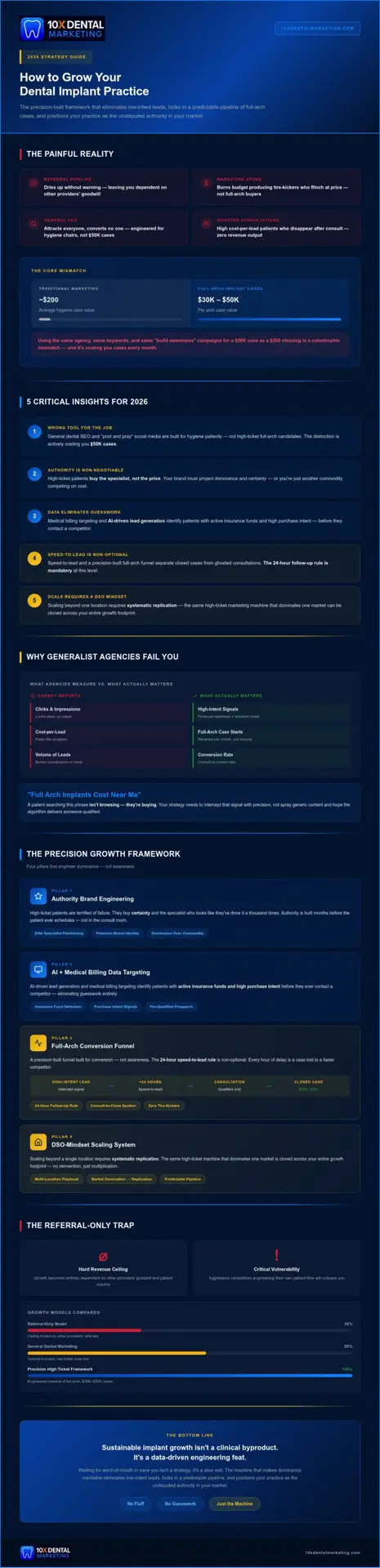
Here’s the truth your competitors don’t want you to figure out: sustainable implant growth isn’t a clinical byproduct. It’s a data-driven engineering feat. This article breaks down the aggressive, precision-built framework that eliminates low-intent leads, locks in a predictable pipeline of full-arch cases, and positions your practice as the undisputed authority in your market. No fluff. No guesswork. Just the machine that makes dominance inevitable.
Key Takeaways
- General dental SEO and “post and pray” social media strategies are engineered to attract hygiene patients, not high-ticket full-arch candidates — and the distinction is costing you $50k cases.
- To grow your dental implant practice in 2026, authority positioning is non-negotiable: high-ticket patients buy the specialist, not the price, and your brand must be built to reflect that.
- Medical billing targeting and AI-driven lead generation eliminate guesswork by identifying patients with active insurance funds and high purchase intent before they ever contact a competitor.
- Speed-to-lead and a precision-built full-arch funnel are the difference between a closed case and a ghosted consultation — the 24-hour rule is not optional at this level.
- Scaling beyond a single location requires a DSO mindset: the same high-ticket marketing machine that dominates one market can be systematically replicated across your entire growth footprint.
Why Traditional Dental Marketing Fails High-Ticket Implant Practices
Most dental marketing was built for a different game. It was engineered to fill hygiene chairs, move preventive care appointments, and generate volume. That model works fine when your average case value hovers around $200. It becomes a catastrophic mismatch when you’re trying to close dental implants at $30,000 to $50,000 per arch. The mechanics are different. The patient psychology is different. The entire acquisition strategy must be different.
Yet most implant practices are still running the same playbook their general dentistry competitors use. Same agency. Same keyword strategy. Same “build awareness” social campaigns. And they’re confused about why their pipeline is full of patients who demand payment plans for a $3,000 single implant while the full-arch cases go somewhere else.
The Generalist Trap: Why Your Current Agency is Failing You
Generalist agencies optimize for what they can measure easily: clicks, impressions, and cost-per-lead. Those metrics look clean in a monthly report. They feel like progress. But a $12 cost-per-click campaign that floods your front desk with unqualified callers isn’t a win. It’s a resource drain dressed up as performance. The fundamental problem is that your agency is treating a $150 cleaning lead and a $50,000 full-arch case as equivalent acquisition targets. They’re not even in the same category. Volume-based marketing doesn’t just fail to deliver high-ticket cases; it actively destroys your front desk efficiency by burying your coordinators in low-intent noise that consumes time without producing revenue.
The High-Ticket Reality: Intent Over Awareness
Brand awareness is a luxury reserved for businesses with infinite runways and patience for slow returns. That’s not the reality of a competitive implant market in 2026. What actually moves the needle is intent. Specifically, high-intent search behavior that signals financial readiness and active decision-making. A patient searching “full arch implants cost near me” isn’t browsing. They’re buying. Your strategy needs to intercept that signal with precision, not spray generic content into the void and hope the algorithm delivers someone qualified.
This is where the concept of Implant Practice Growth demands a precise definition: it’s not about raw patient volume or website traffic. It’s a metric of high-value case starts per month, specifically full-arch and complex implant cases that move your revenue in meaningful increments. To genuinely grow your dental implant practice by that standard, you need a machine built for conversion, not awareness.
Competitors preach clinical education and certifications as the primary growth lever. Both matter. Neither generates a pipeline. Good clinical outcomes earn trust. They don’t manufacture demand. The referral-only model compounds this problem by creating a hard revenue ceiling: your growth becomes entirely dependent on the goodwill and patient volume of other providers. That’s not a strategy. It’s a dependency. And in a market where aggressive competitors are engineering their own patient flow, dependency is a vulnerability you can’t afford.
Engineering Authority: The Brand Development Strategy for Premium Procedures
In the high-stakes world of full-arch restoration, humility is a liability. Patients committing to $50,000 treatment plans aren’t looking for a “friendly neighborhood dentist.” They’re looking for an elite specialist. They’re looking for the absolute authority who can guarantee a result. If your brand doesn’t project dominance, you’re just another commodity. Authority isn’t earned in the consult room. It’s engineered months before the patient ever schedules. The high-ticket patient is terrified of failure. They buy certainty. They buy the specialist who looks like they’ve done this a thousand times. If your marketing looks like every other GP in town, you’ve already lost the case.
Current adult dental health statistics highlight a massive, underserved population with significant tooth loss. These patients represent a gold mine of opportunity, but they won’t trust their complex cases to a generalist. This is why high-performance dental practice brand development is the bedrock of any plan to grow your dental implant practice. It validates your premium pricing before the patient even walks through your door. It creates a digital ecosystem that justifies your fees while your competitors are stuck haggling over insurance copays.
Specialist Authority vs. Generalist Availability
Your digital presence must act as a precise filter. It should repel low-value hygiene shoppers and attract the “whales” looking for full-mouth reconstruction. Stop burying your implant expertise under a mountain of general dentistry services. Your website needs to lead with outcomes, not cleanings. Use high-production video to establish clinical trust instantly. Patients need to see the technology, the precision, and the surgical environment. Forget your dental school graduation date in your bio. No one cares about your degree. They care about how many arches you’ve placed and the lives you’ve transformed. If you want to build a brand that commands the market, you must stop acting like a generalist.
The Multi-Channel Authority Engine
Dominance requires a digital ecosystem that surrounds the prospect. Case studies are your ultimate social proof. Not just before-and-after photos, but deep-dive narratives of complex transformations. Use educational content to move patients from “interested” to “committed.” When you dominate the “Full Mouth Reconstruction” search space, you eliminate the competition by default. This 10X method of total market saturation ensures you are the only logical choice. This is how you grow your dental implant practice without ever competing on price. You aren’t just a dentist anymore. You are the definitive solution to their problem.
The Data Advantage: Using AI and Medical Billing to Find High-Value Leads
Guessing is for amateurs. While your competitors are running broad demographic campaigns and hoping the right patient clicks their ad, the top 1% of implant practices have already moved to a completely different model. They’re not fishing with a net. They’re using precision targeting that identifies high-value patients before those patients even know they’re ready to commit. That’s the fundamental shift required to genuinely grow your dental implant practice in 2026: replace creative guesswork with hard data.
Referral-based growth, the model still championed by practices stuck in the last decade, is slow, unscalable, and entirely outside your control. You’re dependent on other providers’ goodwill and patient volume. That’s not a pipeline. That’s a prayer. Data-driven acquisition eliminates that dependency entirely.
Unlocking Medical Insurance for Dental Implants
Medical billing targeting for dental is the secret weapon most practices never discover. Specific medical diagnosis codes, particularly those tied to conditions like severe periodontitis, edentulism, and jaw bone loss, can qualify patients for medical insurance coverage that directly applies to implant procedures. These patients have active funds sitting unused. They don’t know the money is available. You do. Targeting by medical code transforms your lead quality overnight because you’re reaching patients with documented clinical need and financial resources already in place. That combination is the highest-value lead profile in the entire implant acquisition ecosystem.
AI-Driven Lead Scoring: No More Tire-Kickers
AI doesn’t just find leads. It filters them. The 10X approach to high-intent lead generation uses AI to analyze behavioral signals, search patterns, and billing data simultaneously, predicting implant candidacy before a patient ever fills out a contact form. Specifically, AI cross-references medical billing histories with active search behavior to surface individuals who have both the clinical need and the financial profile to move forward on a full-arch case. What reaches your front desk isn’t a raw lead. It’s a pre-qualified prospect.
The machine-versus-amateur gap is brutal and widening. A creative campaign might generate volume. A data-driven system generates revenue. Your coordinator stops wading through price shoppers demanding discounts on single crowns and starts having conversations with patients who already understand the value of full-arch restoration. That operational shift alone changes the economics of your entire practice. Stop buying leads. Start acquiring patients.
Strategic Patient Acquisition: Converting High-Intent Leads into Full-Arch Cases
A high-intent lead is not a closed case. It’s an opportunity with a shelf life. The moment that prospect submits a form or calls your practice, a clock starts. Your competitors know this. The practices that consistently grow their dental implant practice aren’t the ones with the best clinical outcomes or the most impressive before-and-after gallery. They’re the ones who respond faster, qualify harder, and convert with precision. The entire acquisition machine collapses at the conversion stage if your front desk isn’t built to match the quality of the leads feeding it.
The 24-Hour Rule: Non-Negotiable
Speed to lead isn’t a best practice. It’s a survival mechanism. A full-arch prospect who submits a contact form at 7 PM on a Tuesday is also submitting forms to two or three competitors. The practice that responds first, with a confident, personalized outreach, wins the consultation. Not the best marketer. Not the lowest price. The fastest responder. Your system must include automated acknowledgment within minutes and a live human follow-up within hours. Anything beyond 24 hours is a case you’ve already lost to someone who moved faster.
Implementing a full arch implant marketing funnel built around speed means engineering your intake process the same way you engineer your clinical workflow: with protocols, accountability, and zero tolerance for gaps. Automated SMS sequences, pre-consultation video content, and calendar integrations aren’t optional upgrades. They’re the infrastructure that keeps a hot lead warm until your coordinator can convert it.
The Perfect Consultation Workflow
The consultation room is not where the sale begins. It’s where it closes. By the time a full-arch candidate sits across from your treatment coordinator, they should already be educated, emotionally invested, and financially aware. Pre-consultation content does that work: procedure overview videos, patient transformation stories, and a clear value narrative delivered before the appointment. When the patient arrives, they’re not skeptical. They’re ready.
Inside the consultation, the discovery phase is everything. Your coordinator’s job isn’t to recite treatment options. It’s to uncover the emotional driver behind the decision. Is it a wedding? A career pivot? Years of hiding their smile in photographs? That “why” is the anchor for the entire case presentation. Lead with the transformation. The titanium is irrelevant. The life they get back is the product. When you present a $50,000 plan as the price of a completely rebuilt identity, the number lands differently than when you itemize implants per unit.
Overcoming the Financial Objection
Price objections at this level are almost never about money. They’re about fear. Fear of making the wrong decision. Fear of commitment without certainty. Your response to “I need to think about it” can’t be a polite nod and a brochure. It needs to be a structured, confident reframe: acknowledge the hesitation, reinforce the transformation they described, and introduce the financial pathway that removes friction.
- Third-party financing: Present it as a standard part of the process, not a fallback. Monthly payment framing makes a $50,000 case feel like a manageable decision rather than a catastrophic one.
- Medical billing integration: When applicable, showing a patient that their existing medical coverage reduces out-of-pocket exposure changes the entire dynamic. The financial barrier shrinks. The decision accelerates.
- The spouse objection: Don’t defer it. Invite the conversation. Offer to schedule a second appointment with both decision-makers present. Provide a leave-behind that speaks directly to the partner’s likely concerns around cost, safety, and longevity. Control the narrative before it gets filtered through a kitchen table conversation you’re not part of.
The follow-up sequence is where “lost” leads get recovered. Most practices abandon a prospect after two unanswered calls. A precision-built nurturing sequence, combining automated email, SMS touchpoints, and educational content, keeps your practice top of mind for the patient who wasn’t ready in week one but commits in week six. That pipeline of warm prospects is invisible revenue your competitors are leaving on the table.
If your current intake process isn’t engineered to this standard, the leads your data strategy generates will keep leaking out the bottom. Build the conversion machine that matches your acquisition power.
Scaling Your Dental Empire: The 10X Method for Sustained Growth
One location is a practice. Multiple locations, running the same precision-built acquisition machine, is a business. That distinction isn’t semantic. It’s the difference between a revenue ceiling and a revenue engine with no upper limit. The practices that will dominate implant markets through 2026 and beyond aren’t thinking about their next hygiene hire. They’re thinking about their next market. That requires a fundamental identity shift: from clinician-owner to business architect.
The DSO mindset doesn’t mean selling your equity or surrendering clinical control. It means systematizing every growth lever so the machine runs independent of any single provider, coordinator, or location. When your lead generation, authority positioning, and conversion protocols are standardized—and your physical clinical space is delivered by experts like Multicon Group—each new location you open inherits a proven system on day one. No rebuilding from scratch. No guessing. Just replication at scale.
The DSO Strategy for National Dominance
Standardization is the foundation of multi-location growth. Every location must operate from the same lead generation framework, the same intake protocols, and the same authority infrastructure. The “Authority Engine,” the combination of brand positioning, AI-driven targeting, and medical billing integration, can’t live in one market. It has to be centralized and deployed across your entire footprint simultaneously. That’s how you ensure every chair, in every location, stays at capacity with qualified full-arch candidates rather than low-intent shoppers burning your coordinators’ time.
10X Dental Marketing’s executive team brings direct DSO experience to this exact challenge. The same proprietary medical billing targeting technology and AI-driven lead generation that fills one practice’s pipeline can be scaled to support a multi-doctor ecosystem across multiple markets. You’re not starting over in each new city. You’re deploying a system that already works. That’s the operational advantage that separates high-growth groups from practices that stall at location two.
Sustainable Growth vs. Flash-in-the-Pan Results
Aggressive isn’t reckless. The most aggressive practices in any market are also the most data-obsessed. They track cost-per-case-start, not cost-per-click. They measure revenue-per-location, not impressions-per-campaign. Every dollar of marketing spend feeds a feedback loop that tells them exactly where to reinvest and where to cut. That discipline is what separates sustained dominance from a good quarter followed by a painful correction.
Market shifts eliminate practices that coasted on momentum. They reward practices that built systems. When patient behavior changes, when competitors escalate, when algorithms shift, the data-driven operation adapts in real time. The reactive practice panics. The systematic one recalibrates and accelerates.
You’ve read the full framework. You know what it takes to genuinely grow your dental implant practice at a level your competitors can’t match. The only remaining question is whether you act on it or hand those $50k cases to someone who will. Start engineering your market dominance today.
Your Market Won’t Wait. Neither Should You.
The framework is clear. To genuinely grow your dental implant practice in 2026, three things have to work together: an authority brand that filters out low-value patients before they waste your coordinator’s time, AI-driven data targeting that surfaces pre-qualified full-arch candidates with documented clinical need, and a conversion machine that closes at speed. Remove any one of those pillars and the whole system leaks revenue.
Your competitors aren’t standing still. The practices closing $50k full-arch cases consistently aren’t smarter than you. They’re more systematic. They’ve replaced guesswork with precision, and referral dependency with engineered demand.
10X Dental Marketing is built specifically for this level of play. Backed by an executive team with direct DSO experience, proprietary medical billing targeting technology, and a singular focus on $50k+ case conversions, this is the machine your practice needs to stop competing and start dominating.
Dominate your market with the 10X Dental Marketing machine and turn your implant practice into the undisputed authority your market deserves.
Frequently Asked Questions
How do I get more full-arch dental implant leads?
Stop targeting everyone and start targeting the right people. Full-arch leads come from precision acquisition strategies: high-intent keyword targeting, medical billing data that identifies patients with documented edentulism or severe bone loss, and AI-driven behavioral analysis that surfaces candidates who are actively researching treatment. Volume isn’t the goal. Pre-qualified, financially ready prospects are. A broad lead generation campaign will never outperform a system built specifically for full-arch conversion.
What is the best way to market dental implants in 2026?
The highest-performing implant marketing strategy in 2026 combines authority brand positioning, AI-driven lead targeting, and a conversion-optimized intake process. Generic dental marketing built for hygiene volume can’t close $50,000 cases. What works is intercepting high-intent search behavior, establishing clinical dominance through case-based content, and integrating medical billing targeting to reach patients who already have financial resources aligned with treatment. That three-part system is what separates practices that grow their dental implant practice from ones that stall.
How can AI help grow my dental implant practice?
AI eliminates the guesswork that burns marketing budgets. Instead of demographic targeting based on age or zip code, AI cross-references behavioral signals, search patterns, and billing histories to identify individuals who have both the clinical need and the financial profile for full-arch treatment. What reaches your front desk isn’t a raw lead. It’s a pre-scored prospect. Your coordinators stop fielding price-shoppers and start converting candidates who already understand the value of the procedure.
Is medical billing targeting effective for dental implants?
It’s one of the most underutilized advantages in implant acquisition. Specific medical diagnosis codes tied to conditions like edentulism, severe periodontitis, and jaw bone loss can qualify patients for medical insurance coverage applicable to implant procedures. Targeting by those codes means you’re reaching patients with documented clinical need and existing financial resources they often don’t know are available. That combination produces a lead profile that’s fundamentally different from anything a standard paid search campaign can generate.
Why am I only getting low-intent leads from my current marketing?
Your current marketing was almost certainly built for volume, not value. Generalist agencies optimize for cost-per-click and total lead count because those metrics look good in monthly reports. They don’t distinguish between a patient searching for a teeth cleaning and one actively researching full-arch restoration costs. The result is a front desk buried in unqualified callers while high-ticket candidates convert somewhere else. The fix isn’t a bigger ad budget. It’s a completely different targeting architecture built around intent signals, not impressions.
How much should a dental practice spend on implant marketing?
The right question isn’t how much to spend. It’s what cost-per-case-start is acceptable given your average case value. A practice closing full-arch cases at $50,000 can sustain a significantly higher acquisition cost than one focused on single-unit implants. Rather than setting a fixed monthly budget based on what feels comfortable, build your spend around a target revenue-per-dollar-invested ratio and measure every campaign against case starts, not clicks. That discipline is what separates systematic growth from expensive experimentation.
Can a general dentist compete with specialists for full-arch cases?
Clinically, yes. In the market, it’s harder without deliberate brand engineering. Full-arch patients at the $30,000 to $50,000 price point are buying certainty and authority. If your digital presence leads with general dentistry and buries your implant expertise, you’re already filtered out before the prospect makes contact. A GP who commits to specialist-level positioning, dedicated implant content, outcome-focused case narratives, and a brand that projects surgical authority can absolutely compete. But it requires intentional separation from your general dentistry identity, not just a services page update.
For example, a comprehensive clinic like Christiania Tannlegesenter Frogner demonstrates how a practice can provide essential services like pediatric care while maintaining the clinical infrastructure for advanced surgery.
How do I scale my implant practice to multiple locations?
Scaling requires systematizing every growth lever before you expand, not after. Your lead generation framework, authority infrastructure, intake protocols, and conversion sequences must be standardized so each new location inherits a proven system on day one. The same AI-driven targeting and medical billing integration that fills one practice’s pipeline can be centralized and deployed across multiple markets simultaneously. That’s the DSO mindset: not replicating a practice, but deploying a machine. Without that standardization, location two starts from zero and drains resources instead of generating them.
