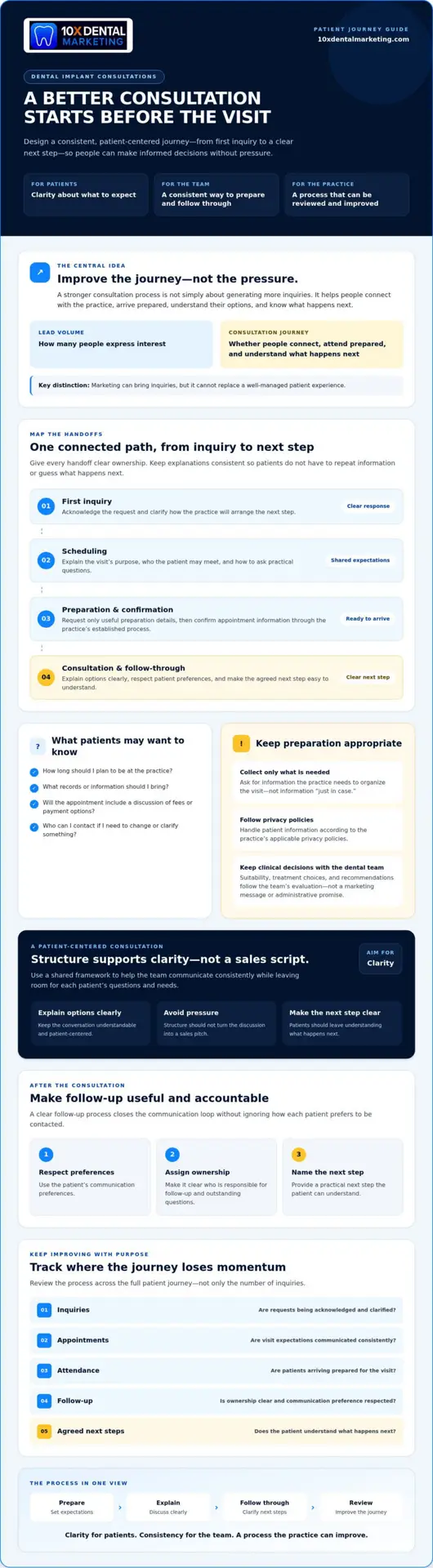
What if better implant consultations depended less on a stronger pitch and more on a better-designed patient journey? Improving the dental implant consultation process starts before the patient sits down. It means creating a consistent experience from the first inquiry through the conversation and next steps, so patients can make informed decisions without pressure.
When team members handle consultations differently, patients may leave with unanswered questions or uncertainty about what happens next. That is more than a communication problem. It is an operations challenge that calls for a clear, repeatable approach.
This guide shows you how to prepare prospective patients, explain options clearly, make next steps easier to understand, and track where the journey loses momentum. It also explains how consistent messaging before the appointment can help patients arrive better prepared. The goal is clarity for patients, consistency for your team, and a process you can improve with purpose.
Key Takeaways
- Map the journey from first inquiry to appointment confirmation so patients know what to expect before they arrive.
- Prepare for each visit with only the information the practice needs, handled according to its privacy policies.
- Use a consistent, patient-centered consultation framework to explain options and next steps without turning structure into sales pressure.
- Make follow-up useful and accountable: respect patient communication preferences, assign clear ownership, and provide a practical next step.
- Track inquiries, appointments, attendance, follow-up, and agreed next steps to keep improving the dental implant consultation process.
Why improving the dental implant consultation process starts before the appointment
A patient can submit an inquiry and still arrive unsure what the appointment involves, what to bring, or what questions to ask. Improving the dental implant consultation process means creating a clear handoff from first contact to informed conversation, not simply generating more inquiries.
An effective implant consultation is a consistent, patient-centered process that helps people understand their options and leave with a clear next step.
That process depends on clear communication, consistent preparation, and dependable follow-through. It is also different from advertising performance. Lead volume measures how many people express interest; the consultation journey shows whether they can connect with the practice, attend prepared, and understand what happens next. Marketing can bring inquiries, but it cannot replace a well-managed patient experience.
What patients need before discussing dental implant treatment
Set expectations without suggesting that a particular treatment is appropriate or promising an outcome. Explain who the patient will meet, what the appointment is intended to cover, and what information the practice would like them to bring. For a foundational overview of what dental implants are, patients may also want a reliable starting point before speaking with the dental team.
Common practical questions include:
- How long should I plan to be at the practice?
- What records or information should I bring?
- Will the appointment include a discussion of fees or payment options?
- Who can I contact if I need to change or clarify something?
Answers should match the practice’s actual process. Clinical suitability, possible treatment choices, and recommendations belong to the dental team after its evaluation, not to a marketing message or an administrative promise.
Where an inconsistent consultation journey can lose trust
Trace each handoff: inquiry response, scheduling, appointment reminders, and arrival. If team members explain the visit differently, patients may have to repeat information or arrive uncertain about what will happen. Unclear ownership can also leave questions unanswered or make the next step vague.
Create a shared communication standard. Record what has already been explained, confirm appointment details consistently, and identify who will handle outstanding questions. Patient-facing messages should match what the team can deliver. For practices promoting full-arch treatment, a full-arch implant marketing strategy should support the same message from inquiry through consultation. Consistency reduces avoidable friction and gives the team a process it can review and improve.
How to prepare dental implant patients for a more productive consultation
A productive appointment starts with a dependable sequence, not a script designed to steer someone toward treatment. Give each team member a clear role, use consistent patient-facing language across calls, forms, reminders, and educational materials, and collect only what the practice needs to prepare for the visit. Follow the practice’s applicable privacy policies when handling that information.
Build a consistent pre-consultation communication sequence
Use this framework from first response through confirmation. Assign an owner to each handoff so inquiries and questions do not get lost between team members.
- Respond and clarify the request. Acknowledge the inquiry, explain how the practice will arrange the next step, and avoid suggesting that an initial conversation confirms treatment eligibility.
- Schedule with clear expectations. Explain what the visit is intended to cover, who the patient may meet, and how to ask practical questions before the appointment.
- Collect useful preparation details. Request information the team needs to organize the visit. Explain which records or details may be helpful to bring, without collecting information “just in case.”
- Confirm the appointment. Share the agreed date, time, and relevant preparation details through the practice’s established communication process. Keep the wording consistent with what the team can deliver.
Patients may also appreciate reliable educational material before they arrive. The patient resources from the American Academy of Implant Dentistry can provide a starting point for general questions, while the consultation remains the place to speak with the dental team.
These steps make improving the dental implant consultation process a practical operations project: define the handoffs, make expectations clear, and check whether each step is completed. Practices reviewing how patient acquisition connects with the consultation journey can explore 10X Dental Marketing.
Prepare the team without turning intake into a sales script
A shared checklist creates consistency without forcing every conversation into identical wording. Include appointment logistics, questions the patient wants answered, information already collected, and the person responsible for the next handoff. Give staff open-ended prompts such as, “What would you most like to understand during your visit?” or “Is there anything you’re unsure about before the appointment?”
Use the responses to prepare the conversation, not to make clinical judgments. The dental team is responsible for assessment and treatment decisions. Administrative and marketing messages should set expectations, capture relevant concerns, and help patients arrive ready to talk without implying a recommendation or outcome in advance.
How to structure the dental implant consultation without pressuring patients
A structured consultation is not a sales script. It helps patients understand the discussion, raise concerns, and know what happens next. Without a shared framework, the conversation can depend too heavily on who leads it, leaving key questions or next steps unclear.
Informed decisions require clear options, plain-language explanations, and room for patient questions.
Improving the dental implant consultation process means standardizing the experience, not dictating a clinical recommendation. A useful framework creates dependable checkpoints while allowing the dental team to adapt the discussion to each patient.
| Consultation element | Inconsistent, provider-led approach | Consistent, patient-centered framework |
|---|---|---|
| Clarity | Explanations and terminology vary; patients may leave unsure what was discussed. | Use plain language, check understanding, and explain relevant options clearly. |
| Patient participation | The provider may dominate the conversation, leaving little space for priorities or questions. | Invite the patient to share concerns and pause for questions throughout. |
| Next steps | The conversation ends without a clear summary of what happens next. | Confirm the agreed next step and who is responsible for it. |
| Follow-up | Ownership and timing may be unclear. | Document what needs follow-up and assign it to the appropriate team member. |
A patient-centered sequence for the consultation
Use a flexible sequence: welcome the patient, ask about their priorities, complete the clinical evaluation, have the care team explain its findings and relevant options, then agree on next steps. Plain language helps, as do pauses. Asking, “What questions does that bring up?” gives patients room to process and respond. This framework supports consistency without imposing a universal script or replacing clinical judgment.
Discussing treatment options and financial questions clearly
Clinical questions should go to the appropriate dental professional. If a patient asks about suitability or treatment details, administrative staff can acknowledge the question and route it rather than speculate. For financial questions, explain the practice’s actual process for discussing fees and payment options. Be clear about what the team can clarify, and do not promise insurance coverage or a specific financial outcome.
For practices reviewing how billing-related targeting connects with patient financial conversations, medical billing targeting for dental practices may be relevant to the broader patient-acquisition context. Keep the consultation focused on clear explanations, patient questions, and an agreed next step.
How to follow up after an implant consultation and keep the next step clear
The consultation may end before the patient’s decision process does. Follow-up should make it easier to continue the conversation, not create pressure to decide. Assign a clear owner, respect the patient’s communication preferences, and make each contact useful.
Create follow-up that respects patient choice
Before the patient leaves, confirm what they agreed to receive, which channel they prefer, and when the practice plans to reconnect. Record those preferences and follow applicable privacy and practice policies. If the patient wants time, acknowledge that choice and clarify whether they would like the practice to check in later or wait for them to reach out.
Build a simple sequence around the patient’s stated needs:
- Recap: Share the agreed next steps and any information the team said it would provide.
- Resolve: Route unanswered clinical questions to the appropriate dental professional, then follow up with the response through the agreed channel.
- Reconnect: Offer a straightforward way to ask another question, pause contact, or schedule another conversation.
Assign each action to a team member and track whether it was completed. Useful follow-up adds clarity. Repeated messages without new information can erode trust, so honor a request to pause or stop contact.
Reduce friction when patients are undecided
Hesitation is not automatically a lost lead, and price may not be the only concern. Train coordinators to ask open questions such as, “What would help you feel clearer about the next step?” The answer may reveal an unanswered question, uncertainty about the process, or a need to discuss the information with someone else.
Offer a defined next step that fits the patient’s request, without inventing urgency the clinical team has not established. If a question concerns clinical suitability or treatment, route it to the dental professional rather than trying to resolve it through follow-up messaging.
Review patterns, not just individual outcomes. Track whether agreed follow-ups were completed, how patients responded, consultation attendance, and whether a next step was agreed. Look for recurring questions that suggest the consultation explanation needs refinement. Improving the dental implant consultation process means reviewing communication and handoffs over time, not pushing for faster decisions.
For practices examining how patient acquisition connects with the consultation journey, explore 10X Dental Marketing as a potential strategic partner.
How to measure consultation improvements and choose the right growth support
Improving the dental implant consultation process takes more than tracking a single conversion figure. A final outcome cannot show whether momentum was lost at inquiry, scheduling, attendance, follow-up, or the next-step conversation. Track each stage separately, then review the handoffs that connect them.
Choose measures that reveal where the process needs work
Use practice-defined measures consistently. For example, record how quickly inquiries receive a response, how often they become scheduled appointments, whether patients attend, whether agreed follow-ups are completed, and whether a next step is established. Track patient questions too. Repeated confusion can reveal a communication gap that a conversion figure alone will not explain.
Choose a measurement period that fits the practice and keep it consistent when comparing results. If the team changes a reminder message or intake step, note when it changed and review data over the same defined periods. Avoid crediting one adjustment for a shift in outcomes unless the evidence supports that connection. Pair the numbers with feedback from staff who hear patient questions firsthand.
Make the review cross-functional. Marketing can explain the message and source of inquiries; front-desk staff can describe response and scheduling handoffs; coordinators can share follow-up patterns; and the clinical team can flag where patients arrive unclear about the consultation. Together, they can identify whether the issue lies in expectation-setting, process ownership, or another part of the journey.
Decide when marketing support can improve the consultation journey
Consider outside support when the practice is attracting relevant inquiries but the transition into consultation feels disconnected, or when patient-facing messaging does not match what the team can consistently deliver. Evaluate a potential agency on relevant experience, clear reporting, and its ability to coordinate campaign messaging with the practice’s actual workflow. Ask how it distinguishes acquisition measures from appointment and follow-up measures.
10X Dental Marketing offers full-arch implant marketing campaigns and AI-driven lead generation for practices evaluating that kind of support. These services can be assessed against the practice’s goals, operational capacity, and measurement approach. They are not promises of patient decisions or business results. The consultation journey still depends on clear handoffs and a consistent experience inside the practice.
Talk with 10X Dental Marketing about connecting patient acquisition with a stronger consultation journey.
Turn a clearer consultation journey into your next improvement
Improving the dental implant consultation process is a practice-wide effort, not a stronger sales pitch. Build a consistent experience from inquiry to follow-up, with clear ownership at each handoff. Patients should understand what to expect, have space to ask questions, and know the next step without feeling pushed.
Keep refining the journey with evidence. Review where inquiries lose momentum, listen for recurring patient questions, and bring marketing, front-desk, coordinator, and clinical perspectives together. This gives the team a practical way to improve communication while keeping clinical decisions where they belong.
When patient acquisition and consultation operations need to work more closely, 10X Dental Marketing offers full-arch implant marketing campaigns, AI-driven lead generation, and medical billing targeting. Its executive team also brings experience with nationally recognized Dental Support Organizations. Consider whether that experience fits your practice’s goals.
With a clear process and regular review, your practice can create a more informed, consistent experience for prospective patients.
Frequently Asked Questions
How can a dental practice improve its implant consultation process?
Start by mapping what happens from the first inquiry through the patient’s agreed next step. Assign ownership for each handoff, align messages across calls and reminders, and make sure patients know what the appointment will cover. Then review response, scheduling, attendance, and follow-up measures over a consistent period. Improving the dental implant consultation process is an ongoing practice improvement effort, not just a marketing adjustment.
What should happen during a dental implant consultation?
A consultation should give the patient space to explain their priorities and ask questions while the dental team conducts its evaluation and discusses relevant findings and options. The team should use clear language, pause to check understanding, and clarify what happens next. Clinical suitability and treatment recommendations belong to qualified dental professionals. The exact discussion will depend on the patient’s circumstances and the practice’s clinical process.
How long should a dental implant consultation take?
There is no single appropriate duration for every consultation. The time needed can depend on the patient’s questions, the information the dental team needs to review, and the practice’s appointment process. Rather than setting an arbitrary target, allow enough time for the team to complete its evaluation, explain relevant information, and discuss next steps without rushing. Practices can review appointment flow and patient feedback to see whether the schedule supports that conversation.
Can a dental implant consultation process improve case acceptance?
A clear, consistent process can help patients understand the discussion, raise concerns, and make a more informed decision. It may also help the practice identify where communication or follow-up needs attention. However, no consultation framework can guarantee that a patient will accept treatment. Decisions depend on individual circumstances and clinical recommendations. Measure the patient journey carefully, and do not treat case acceptance alone as proof that a process is effective.
What happens if a patient is not ready to decide after the consultation?
Give the patient room to consider the information without treating hesitation as rejection. Ask whether a question remains unanswered or whether they would prefer time before reconnecting. If they agree to follow-up, confirm their preferred channel and timing, then provide something useful, such as an agreed recap or an answer routed to the dental team. Respect a request to pause contact, and do not imply urgency that the clinical team has not established.
How should a practice follow up after an implant consultation?
Follow up according to what the patient agreed to receive and the practice’s communication policies. Make each contact purposeful: recap agreed next steps, answer a question through the appropriate team member, or offer a simple way to reconnect. Assign a staff owner and record whether the follow-up was completed. Reviewing completion alongside attendance and agreed next steps helps the practice spot handoff gaps without relying on repeated, high-pressure messages.
Should dental implant consultations use a standard script?
Use a shared framework, not a rigid word-for-word script. A consistent sequence can help the team cover patient priorities, clinical evaluation, explanations, questions, and next steps. The conversation should still adapt to the individual, and clinical judgment must remain with the dental team. Give staff prompts that invite discussion, such as asking what the patient most wants clarified. This supports a reliable experience without making the appointment feel rehearsed or pressured.