A campaign can win the click and still lose the patient. If your reports celebrate impressions and lead volume but can’t show who booked, attended, or started treatment, you’re measuring activity, not growth. The key performance indicators for dental marketing should connect each campaign to the patient outcomes your practice wants to achieve.
It’s frustrating when inquiries rise but appointment attendance or treatment acceptance stays weak. When advertising, call tracking, scheduling, and practice-management data sit in separate systems, it can also be hard to see where leads drop out or which channel is earning its place in the budget.
This article shows how to build a practical scorecard around your growth objective, from qualified inquiries and cost per scheduled appointment to attended visits and treatment starts. You’ll learn how to define each metric, compare campaigns using consistent data, and identify the handoff that needs attention. For higher-value procedure marketing, raw lead counts aren’t enough. Track the full journey and make every report answer the question that matters: is marketing producing valuable patient care?
Key Takeaways
- Choose key performance indicators for dental marketing that match a specific practice-growth objective, not just channel activity.
- Define qualified inquiries, campaign spend, and attended appointments clearly so KPI formulas stay consistent across data sources.
- Use measures from each funnel stage to identify whether leads are dropping off before booking, attending, or starting treatment.
- Build a concise scorecard, validate its data, and use regular reviews to decide what to adjust instead of relying on universal targets.
- When evaluating a marketing partner, ask how it handles attribution, data access, reporting, and procedure-specific conversion tracking.
What Key Performance Indicators for Dental Marketing Actually Measure
The key performance indicators for dental marketing should show whether marketing is advancing a defined practice objective, not simply generating activity. A Key Performance Indicator (KPI) is a measurable indicator used to assess progress toward an objective. In dental marketing, that could mean measuring how effectively a campaign for a specific procedure moves prospective patients from initial interest to treatment.
A dental marketing KPI is a measurable indicator that connects marketing activity to progress toward a defined patient or practice objective over a stated period. Without a defined objective, a number has little meaning. Without a reporting period, comparisons can be misleading.
How KPIs differ from marketing metrics
Impressions and clicks describe channel activity. They can help diagnose reach or engagement, but they don’t show whether a campaign is producing patient outcomes. A KPI answers a decision question: is the campaign generating qualified inquiries, attended appointments, or treatment starts that support the practice’s goal?
For example, a practice promoting a procedure might track clicks to see whether an ad is attracting attention, then assess qualified inquiries from the same campaign to judge whether that attention is relevant. Clicks still help explain performance, but the objective determines which measures should guide decisions.
Map measurement to the dental patient journey
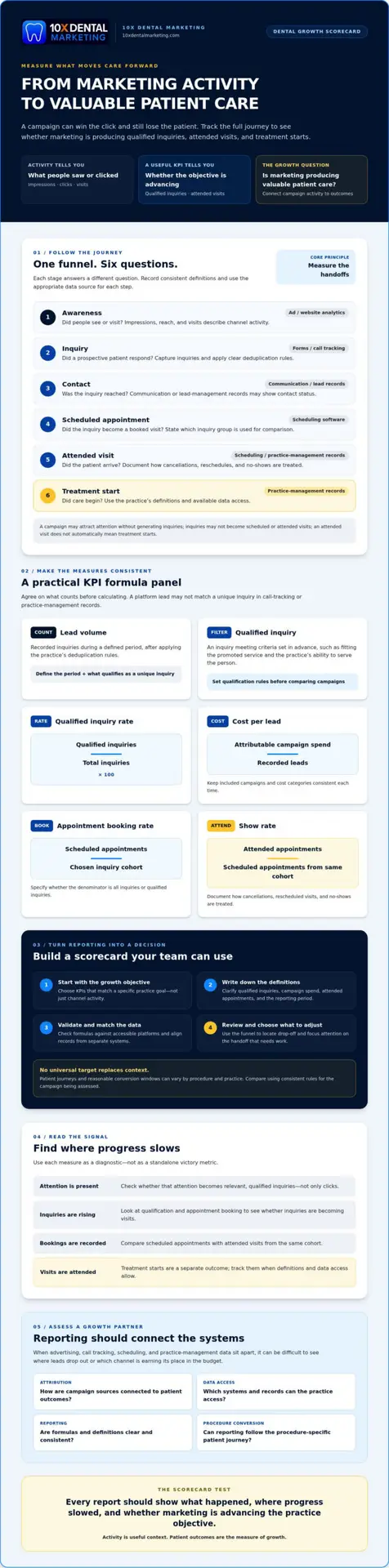
Measurement should follow the patient’s path, while recognizing that records vary by practice and platform. Potential data sources include:
- Awareness: Ad or website analytics may record impressions, reach, and visits.
- Inquiry: Forms, call-tracking tools, or other inquiry records may capture a prospective patient’s response.
- Contact: Communication or lead-management records may show whether the inquiry was reached.
- Scheduled appointment: Scheduling software may record whether a visit was booked.
- Attended visit: Scheduling or practice-management records may indicate whether the patient arrived.
- Treatment start: Practice-management records may show whether care began, subject to the practice’s definitions and data access.
Each stage answers a different question. A campaign may attract attention but generate few inquiries. Inquiries may come in but fail to become scheduled or attended visits. An attended visit doesn’t automatically mean treatment starts.
Define each stage before comparing results. Patient journeys and reasonable conversion windows can vary by procedure and practice, so use consistent rules for the campaign being assessed. This helps the team see where progress slows and which next decision the data can support.
The Core Dental Marketing KPIs: Definitions, Formulas, and Data Sources
Useful key performance indicators for dental marketing need shared definitions. A lead in an advertising platform may not match a unique inquiry in call-tracking or practice-management records. Before calculating results, decide what counts, which campaign costs are included, and how records from different systems will be matched. Check each formula against the platforms and data the practice can access.
Lead and appointment KPIs to calculate consistently
Start with a small set of funnel measures. Lead volume is the count of recorded inquiries during a defined period, after applying the practice’s deduplication rules. A qualified inquiry meets criteria set in advance, such as fitting the promoted service and the practice’s ability to serve the person. The qualified inquiry rate is qualified inquiries divided by total inquiries, multiplied by 100.
- Cost per lead: Attributable campaign spend divided by recorded leads. Keep the spend boundary consistent, including the same campaigns and cost categories each time.
- Appointment booking rate: Scheduled appointments divided by the chosen inquiry cohort. State whether the denominator includes all inquiries or only qualified inquiries.
- Show rate: Attended appointments divided by scheduled appointments from the same cohort. Document how cancellations, rescheduled visits, and no-shows are treated.
- Cost per attended appointment: Attributable campaign spend divided by attended appointments. Use the same campaign boundary and reporting window for each comparison.
Document deduplication rules, cohort dates, cancellations, and reporting windows. Otherwise, two reports can use the same KPI name and still produce different results.
Treatment and acquisition KPIs that connect to outcomes
Treatment acceptance rate can be calculated as the number of eligible consultations that accept the proposed treatment divided by all eligible consultations in that cohort. Define eligibility and what “accepted” means, such as a recorded decision to proceed. Track treatment starts separately because acceptance and beginning care are distinct events. Scheduling or practice-management systems may record these later stages, while advertising and call-tracking platforms may capture earlier ones.
Patient acquisition cost is attributable marketing spend divided by the number of acquired patients attributed to that spend. Use it only when the practice can support both the spend total and patient attribution. If the source data can’t connect a patient to a campaign with reasonable consistency, label the result incomplete instead of presenting it as definitive.
Cost per lead and cost per acquired patient answer different questions: one measures the cost of generating an inquiry, while the other measures the cost of acquiring a patient. Neither metric alone establishes profitability. Revenue from started treatment is not profit, and it should be assessed alongside relevant operating costs. For a broader practice-management perspective, the California Dental Association outlines six popular KPIs. Practices assessing specialized campaigns can also review how procedure-focused dental marketing aligns reporting with campaign goals.
Why More Dental Marketing Leads Do Not Always Mean Better Performance
A rising lead count can look like momentum, but volume alone can’t show whether inquiries fit the service, become appointments, or lead to treatment. A campaign that generates more form submissions may still produce fewer attended visits than one with fewer, better-qualified inquiries. The California Dental Association’s discussion of key performance indicators reinforces the value of connecting practice measures to marketing effectiveness.
A campaign’s lead quality can only be judged against a documented definition of “qualified,” applied consistently to every inquiry. Decide what makes an inquiry relevant to the promoted service and how the team will record that decision. Without shared criteria, one channel’s “lead” may not be comparable to another’s.
Compare channel activity with patient progression
Use activity measures to diagnose attention, then follow the patient journey to assess outcomes. For example, a full-arch implant campaign may generate impressions, clicks, and form submissions. Those figures don’t reveal whether inquiries were reached, appointments were scheduled and attended, or treatment started.
Activity and early response: Impressions, clicks, and form submissions show exposure and initial engagement.
Qualified progression: Qualified inquiries and contacted leads show whether responses fit the campaign objective and move forward.
Patient outcomes: Attended visits and treatment starts show progression beyond marketing interaction.
Compare channels only when spend, attribution, cohort, and conversion-window rules are consistent. This matters when comparing distinct campaigns, such as dental sleep medicine and implant marketing. Their patient journeys may differ, so one conversion window or definition may not describe both fairly.
Find the bottleneck before changing campaign spend
Trace the drop-off before deciding what to change. Suppose a dental sleep medicine campaign records inquiries, but few are marked as contacted. First check whether contact attempts are recorded consistently and whether inquiries can be matched to the correct source. If contact is documented but scheduling remains low, review the handoff and appointment availability. If appointments are booked but not attended, examine attendance and follow-up records before changing channel investment.
Marketing and practice operations both shape the funnel. Response time, contactability, scheduling capacity, and follow-up can affect whether an inquiry progresses. A weak downstream result may point to an operational handoff, a tracking gap, a campaign mismatch, or several issues at once.
Use the key performance indicators for dental marketing to locate where progression slows. Validate the data and patient-stage definitions first, then assign the next action to the part of the process the evidence identifies.
How to Build a Dental Marketing KPI Scorecard Your Team Can Use
A useful scorecard turns reporting into a repeatable decision process. Keep it lean: choose measures that show whether a specific growth objective is moving forward, and give each measure a clear owner and source. The key performance indicators for dental marketing should help the team decide what to protect, investigate, and change next.
Choose KPIs that match the practice objective
Start by naming the goal: grow qualified inquiries, improve appointment progression, support available scheduling capacity, or assess a specific procedure line. Then select a small number of KPIs that show progress at relevant stages, rather than filling a dashboard with every available metric. For each KPI, record its name, formula, owner, source, cohort, and reporting period.
Separate leading indicators, such as qualified inquiries or scheduled appointments, from lagging indicators, such as attended visits or treatment starts. Leading indicators can flag changes earlier. Lagging indicators show whether those changes carried through to patient outcomes. Neither needs a universal target. Interpret results against the practice’s objective, capacity, and validated historical data.
Create a review rhythm that drives action
Review the scorecard on a consistent cadence that fits campaign volume and practice operations. Keep the process focused:
- Set the objective: State the practice or procedure-line goal the scorecard supports.
- Choose stage KPIs: Include measures that show progression toward that goal.
- Define sources and owners: Assign responsibility for lead status, appointment outcomes, and consistent campaign-source records.
- Validate: Check that definitions, cohort dates, attribution, and formulas match the systems and data available.
- Review and act: Identify a gap, agree on a specific change, then record what was tested and what the next review showed.
Assign ownership before discussing results. For example, the person responsible for lead records can confirm inquiry status, while the team member overseeing scheduling can verify appointment outcomes. This makes missing or inconsistent records visible instead of letting them distort campaign comparisons.
Record which segment was affected by each test, such as a campaign or procedure line, along with the change and observed result. Where possible, use validated, aggregated reporting. Before sharing or handling identifiable patient information, confirm applicable privacy, consent, access, and data-handling requirements with qualified counsel. Give each person access only as appropriate to their role and the approved process.
If your reports don’t connect campaign activity to patient progression, assess your dental marketing measurement approach and identify where clearer reporting could support better decisions.
Use Dental Marketing KPIs to Evaluate Your Next Growth Partner
A growth partner should be able to explain how campaign activity connects to patient progression, not just present a polished lead report. Use the key performance indicators for dental marketing you’ve defined to assess whether an agency’s reporting is clear, consistent, and useful for decisions.
Questions to ask before comparing marketing partners
Ask direct questions. The answers will show whether you can evaluate performance or will simply receive numbers.
- Definitions: How do you define a lead, qualified inquiry, scheduled appointment, and acquired patient? Who agrees on those definitions?
- Attribution: Which systems provide the data? How do you handle duplicate inquiries, missing campaign sources, and records that can’t be attributed?
- Data access: What reporting can the practice review, and how are sources and calculations documented?
- Optimization: How do you distinguish campaign performance from scheduling capacity, contactability, or follow-up constraints before recommending a change?
Look for answers that make the measurement process understandable and verifiable. If a report shows a drop between inquiry and appointment, the agency should explain what data supports that finding and what further checks are needed before assigning responsibility.
Match measurement depth to the procedure line
Procedure-specific campaigns can require distinct cohorts and conversion-stage reporting. A form submission for a high-consideration service is an early signal, not proof of an attended consultation or treatment start. Agree on how inquiries will be grouped by campaign or procedure and how each stage will be tracked over a suitable, consistently applied window.
For procedure context, review full-arch implant marketing. 10X Dental Marketing manages specialized marketing and lead-generation campaigns for full-arch implant and dental sleep medicine practices. Its service mix also includes AI-driven lead generation and medical billing targeting. Assess these campaign approaches against your goals, not as guarantees of results.
Choose a partner based on transparent definitions, traceable data, and reporting that supports practical decisions. Review your dental marketing growth strategy with 10X Dental Marketing.
Turn Better Measurement Into Your Next Growth Move
Strong dental marketing decisions start with a clear objective and a compact scorecard. Track the patient journey beyond clicks and inquiries, using consistent definitions for qualified leads, appointments, and treatment starts. Then review the data to find the stage that needs attention before changing campaign spend.
The key performance indicators for dental marketing are most useful when they connect campaign activity to practice outcomes and give your team a clear next step. Validate data sources, assign ownership, and compare campaigns using consistent attribution rules. For procedure-focused marketing, make sure reporting reflects the journey for that service.
10X Dental Marketing specializes in full-arch implant and dental sleep medicine marketing, with offerings that include AI-driven lead generation and medical billing targeting. If you’re ready to assess whether your reporting connects campaigns to patient outcomes, review your dental marketing growth strategy with 10X Dental Marketing.
Build the scorecard, strengthen the handoff, and give your next growth decision a clearer foundation.
Frequently Asked Questions
What are the most important KPIs for dental marketing?
There’s no universal set of KPIs for every practice. Start with the growth objective, then track a concise group across the patient journey: qualified inquiries, scheduled appointments, attended visits, treatment starts, and attributable campaign spend. Define each measure, its data source, cohort, and reporting period before comparing results. The right scorecard shows where demand comes from and where prospective patients stop progressing, helping the team decide what to investigate next.
How do you calculate cost per lead for a dental practice?
Divide the campaign spend included in your reporting period by the leads recorded for that same period. Document which channels, fees, and lead sources are included, and apply the same deduplication rules each time. Cost per lead measures the cost of generating inquiries, not their quality or whether they become patients. Compare it with qualified inquiries, attended appointments, and treatment starts before deciding whether a campaign is performing well.
What is a good dental marketing conversion rate?
A useful conversion-rate target depends on the procedure, audience, channel, practice capacity, measurement window, and exact conversion being counted. A general benchmark may not be a reliable comparison when those conditions differ. First, establish a baseline using consistent definitions and cohorts. Then set a realistic improvement goal with the practice team. Review whether changes improve qualified inquiries, attended visits, or treatment starts, not just clicks or form submissions.
How can a dental practice track marketing leads to actual patients?
Use consistent source tracking from the first inquiry through contact, scheduling, attendance, and treatment status. Agree on stage definitions with the marketing and front-office teams, record outcomes in appropriate systems, and apply clear rules for duplicate records. Check missing or unattributed sources regularly. The key performance indicators for dental marketing are only as useful as the data behind them, so limit access to patient information and verify applicable privacy and data-handling requirements before connecting or sharing systems.
Should dental practices track leads, appointments, or treatment starts?
Track all three when reliable data is available because each reveals a different stage. Leads show incoming demand, appointments show whether inquiries progress to scheduling, and treatment starts record a later outcome. Looking at only one stage can hide a bottleneck or create a misleading picture. Use consistent definitions and cohort dates, then interpret changes alongside staffing, appointment availability, follow-up, and campaign activity before deciding what needs attention.
How often should a dental practice review marketing KPIs?
Set a consistent review cadence that fits campaign volume, data reliability, and the time patients need to progress through the journey. Check operational issues often enough to respond, but don’t draw conclusions from incomplete cohorts. Schedule deeper reviews to compare channels, procedure lines, and downstream outcomes. Record what changed, when it changed, which segment was affected, and what KPI should move before assessing the result.
What is the difference between a dental marketing metric and a KPI?
A metric records an activity or result, such as clicks, calls, or form submissions. A KPI is a selected measure tied to a specific objective and used to guide a decision. The same metric can be a KPI in one context and supporting data in another. Define why each number matters, who owns it, and what action the team will consider if it changes. That turns reporting into a decision tool.