What should a dental implant practice expect to pay for a genuinely qualified lead? The average cost per lead for dental implants can vary widely by agency and channel. But a low number means little if inquiries can’t be reached, aren’t a fit, or never become consultations.
It’s frustrating when reports count leads differently or separate ad spend from agency fees. A raw inquiry can make a campaign look efficient while hiding what it costs to start a real patient conversation. Rather than chase the cheapest lead, compare campaigns on equal terms and track what happens after someone responds.
This article explains why implant lead costs vary, how to calculate and compare them fairly, and which metrics connect inquiries to booked consultations and accepted treatment. Use the practical framework to evaluate lead quality, follow-up, and total marketing spend, so your benchmarks support stronger decisions. That’s the difference between counting names and measuring patient acquisition.
Key Takeaways
- The average cost per lead for dental implants is useful only when the lead definition, campaign scope, and reporting period are consistent.
- Competition, search intent, audience fit, and landing-page experience can all influence how efficiently campaigns generate inquiries.
- Compare Google Ads, paid social, organic activity, and referrals using the same cost and attribution rules, not headline CPL alone.
- Track deduplicated leads beyond the initial inquiry to see which become qualified prospects and booked consultations.
- Use a proposal-review checklist to assess targeting, intake, reporting, attribution, and campaign optimization before judging performance.
What Is the Average Cost Per Lead for Dental Implants, and What Counts as a Lead?
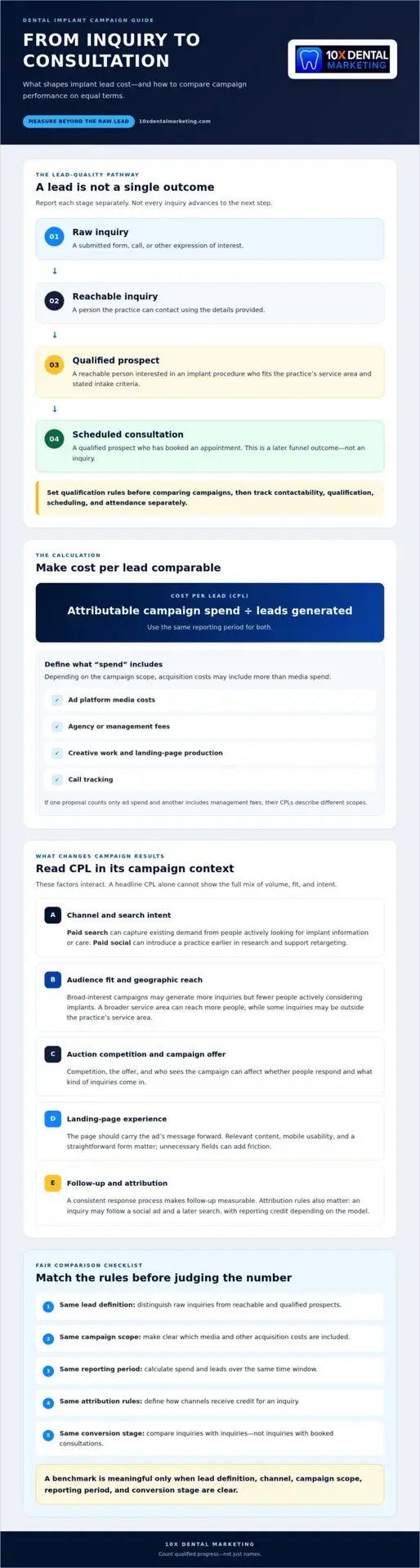
There’s no single reliable average cost per lead for dental implants unless the lead definition and campaign scope match. A report counting every form submission can’t be compared fairly with one counting only reachable, qualified prospects. Start with a clear formula: cost per lead (CPL) equals attributable campaign spend divided by leads generated during the same reporting period. The Cost per lead (CPL) model measures acquisition by inquiry, not by click or completed treatment.
Define “spend” as carefully as “lead.” An ad platform may report media costs and conversions, while a practice’s full acquisition costs may also include agency fees, creative work, landing-page production, or call tracking. If one proposal includes only ad spend and another includes management fees, their CPLs describe different scopes. Third-party figures can provide context, but they aren’t guaranteed results or universal benchmarks for every practice.
Why dental implant lead-cost averages can mislead
Campaign conditions change the numbers. Channel, geographic reach, auction competition, offer, and patient intent all affect who sees an ad and whether they respond. A broad-interest campaign may generate more inquiries but fewer people actively considering implants. A focused campaign may have a different CPL and a different mix of prospects. Neither headline figure tells the full story without consistent definitions, time periods, and included costs.
Which implant lead should your practice count?
Separate each step instead of treating every response as equivalent:
- Raw inquiry: A submitted form, call, or other expression of interest.
- Reachable inquiry: A person the practice can contact using the details provided.
- Qualified prospect: A reachable person who has expressed interest in an implant procedure and fits the practice’s service area and stated intake criteria.
- Scheduled consultation: A qualified prospect who has booked an appointment.
Set qualification rules before comparing campaigns, then report each stage separately. A consultation is a later funnel outcome, not an inquiry. This distinction matters especially for full-arch campaigns, where audience targeting and follow-up are part of a connected acquisition process. Explore the full-arch implant marketing strategy for a closer look at that approach.
Lead cost is comparable only when campaign scope, reporting period, and lead qualification match. Apply that rule before treating an average or proposal as a meaningful benchmark.
What Drives the Cost Per Lead for Dental Implant Campaigns?
Implant campaign costs don’t change for just one reason. Auction competition, search intent, audience fit, and geographic reach interact. A person searching for a specific implant solution may be closer to taking action than someone who encounters an implant ad while browsing social media. A campaign targeting a broad area can reach more people, but some inquiries may fall outside the practice’s service area. These differences affect both response volume and lead quality.
That’s why the average cost per lead for dental implants needs context. A benchmark without the channel, lead definition, and conversion stage can make very different campaigns look comparable.
How channel and targeting change reported CPL
Paid search can capture existing demand from people actively looking for implant information or care. Paid social can introduce a practice to potential patients earlier in their research and support retargeting when they return to explore. Each channel can play a different role, so comparing raw CPLs alone may miss how they contribute across the patient journey.
Attribution adds another layer. Someone might first see a social ad, later search for the practice, and then submit a form. Depending on the reporting model, that inquiry could be credited to either touchpoint. Clear channel definitions and consistent attribution rules make the comparison more useful. For an example of how automation can support lead-generation workflows, see the AI dental lead generation approach.
How conversion systems affect acquisition efficiency
The ad earns attention, and the landing page needs to carry the message forward. If an ad promotes implant consultations but sends visitors to a general page with no clear next step, that mismatch can weaken inquiry conversion. Relevant page content, mobile usability, and a straightforward form all matter. Unnecessary fields can add friction, while too little information can make it harder to assess an inquiry.
Lead handling matters too. A consistent response process helps the practice connect with people while their interest is active. It doesn’t guarantee a consultation, but it makes follow-up measurable. Track campaign volume separately from contactability, qualification, consultation scheduling, and attendance.
Implant decisions can involve research and consideration, and treatment needs vary by patient. Structured follow-up is important: an initial inquiry may need more than one useful interaction before the person is ready to schedule. Avoid judging a campaign solely by its first wave of submissions.
A benchmark is meaningful only when lead definition, channel, and conversion stage are clear. That context turns headline CPL into a performance measure. Practices building a connected acquisition and follow-up system can explore 10X Dental Marketing’s implant marketing approach.
How to Compare Dental Implant Lead Costs Across Channels and Proposals
A channel comparison is useful only when every campaign is measured on the same basis. Compare the average cost per lead for dental implants using consistent dates, geographic scope, procedure focus, lead criteria, and attribution rules. Then break out each proposal’s costs instead of accepting one blended figure: media spend, management fees, creative, technology, and lead intake may be counted differently.
What to include in an apples-to-apples CPL comparison
Use one reporting period and qualification threshold across the comparison. Decide whether repeat inquiries count once or multiple times, and record how long after an ad interaction a conversion can receive credit. A Google Ads lead and an organic inquiry can both matter, but their acquisition costs shouldn’t be treated as identical without consistent cost and attribution rules.
| Channel | Spend included | Lead definition | Attribution window | Downstream outcome |
|---|---|---|---|---|
| Google Ads | Media, fees, creative, technology, intake | Form, call, or qualified inquiry | Window and credit rule used | Qualified consultations and later results |
| Paid social | Media and campaign-related costs | Same threshold as other channels | Click-through or view-through rule | Consultations, attendance, and treatment |
| Organic activity | Included content and optimization costs | Tracked inquiry tied to organic source | Source and attribution rule | Consultations and later results |
| Referrals | Tracked referral-related costs, if any | New patient inquiry from referral | Referral recording rule | Consultations and later results |
Use the table as a reporting template, not as a claim that every channel has the same cost structure. Competitor-published figures are directional unless their methods, populations, campaign scope, and lead definitions match yours.
Why the lowest implant CPL may not be the strongest result
A low CPL can hide weak-fit inquiries that take staff time but don’t progress. Compare each channel beyond acquisition: qualified prospects, consultations scheduled, attendance, treatment acceptance, and collected revenue. Those measures reveal whether lower-cost volume is actually advancing patient acquisition.
For example, if one proposal reports form fills and another reports qualified prospects, the first may appear cheaper while delivering less useful demand. Before drawing a conclusion, ask for a clear breakdown of included costs, deduplicated leads, attribution, and funnel outcomes. Practices assessing patient audiences alongside financial considerations can explore medical billing targeting for dental practices.
Strong comparisons show the full path from campaign investment to patient outcome. For a connected approach to acquisition and conversion measurement, explore 10X Dental Marketing.
How to Calculate and Track Your Dental Implant Cost Per Lead
A useful CPL calculation starts with two things: a defined cost scope and a clean count of unique leads. Use this formula:
Dental implant CPL = attributable campaign costs ÷ deduplicated leads that meet the practice’s stated definition.
Choose one reporting period, such as a calendar month, and apply the same attribution rules to every campaign you compare. Record how long after an ad interaction a lead can be credited to that campaign. Consistent timing and rules prevent costs from one period being matched against leads generated in another.
A repeatable monthly CPL calculation
- List included costs. Record media spend, management fees, creative expenses, technology, and any lead-management costs included in your calculation. State clearly what’s excluded.
- Count qualifying unique leads. Remove duplicates and apply documented criteria, such as implant procedure interest, contactability, and service-area fit.
- Calculate and label CPL. Divide the included costs by the qualifying lead count. Report the period, channel, lead definition, and attribution window beside the result.
Use a simple worksheet to make the calculation repeatable:
- Reporting period: [start date] to [end date]
- Channel or campaign: [campaign name]
- Included costs: [media] + [management] + [creative] + [technology] + [intake]
- Attribution rule and window: [documented rule]
- Deduplicated leads meeting criteria: [lead count]
- CPL: [included costs] ÷ [qualifying lead count]
This gives the average cost per lead for dental implants a defined basis. It also makes changes easier to interpret: if lead criteria or included expenses change, note that alongside the new result rather than presenting it as a direct comparison.
Metrics that explain whether leads create business value
CPL measures acquisition cost, not the whole patient journey. Track each stage to see where momentum holds or drops:
- Inquiry to contact: How many leads could the team reach?
- Contact to qualification: How many met the practice’s criteria?
- Qualified lead to consultation: How many booked?
- Consultation to attendance: How many arrived?
- Consultation to treatment: Where available, track treatment acceptance and collected revenue using consistent attribution.
Review these measures over time rather than treating one short reporting period as a verdict. If your team wants a connected view of implant acquisition and conversion measurement, explore 10X Dental Marketing’s approach.
Turn Implant Lead-Cost Data Into a Smarter Patient-Acquisition Decision
Use one decision rule: judge cost per lead alongside lead quality, consultation outcomes, and exactly what the reported costs include. The average cost per lead for dental implants is a starting point, not a verdict. A campaign with a higher CPL may still be more valuable if it produces better-qualified prospects and more attended consultations. A lower CPL can mislead if inquiries rarely progress or the calculation leaves out major campaign expenses.
A checklist for evaluating an implant marketing system
Before approving a proposal or changing a campaign, make sure its reporting shows the path from marketing activity to patient response. Look for clear ownership of measurement, not just a headline lead count. Use this checklist:
- Does reporting separate raw inquiries, qualified leads, and scheduled consultations?
- Are audience and procedure targeting clearly described?
- Are attribution rules and included costs documented?
- Are intake and follow-up outcomes tracked alongside campaign data?
- Is there a defined process for reviewing results and optimizing campaigns?
Marketing and intake are connected stages. If reports stop when an inquiry arrives, the practice can’t see whether response processes, qualification, or consultation scheduling are affecting performance. Track those handoffs to identify where the system needs attention.
Move from benchmark comparisons to a growth plan
Once the evaluation framework is clear, build a plan around the patient journey and the procedures the practice wants to grow. Specialized full-arch implant campaigns can align targeting and messaging with that focus. AI-driven lead generation and medical billing targeting can support a broader acquisition strategy, with performance assessed through consistent reporting rather than assumed outcomes.
Brand authority and conversion optimization matter, too. Clear positioning helps prospective patients understand the practice’s focus, while relevant landing pages and consistent intake processes carry that message through to the next step. Explore dental practice brand development as part of a strategy that connects awareness with patient acquisition.
For a growth plan grounded in targeting, qualification, and conversion measurement, connect with 10X Dental Marketing about your implant marketing strategy.
Build a More Accountable Implant Growth Strategy
The average cost per lead for dental implants is useful only when you know what counts as a lead, which costs are included, and how inquiries progress. Compare campaigns on consistent terms, then look beyond CPL to qualified prospects, consultations, attendance, and treatment outcomes. That’s how you separate inexpensive activity from meaningful patient acquisition.
Strong performance depends on a connected system: targeted campaigns, clear reporting, and intake processes that carry inquiries toward consultation. 10X Dental Marketing provides specialized full-arch implant marketing, AI-driven lead generation, and medical billing targeting for dental practices, supported by leadership experience with nationally recognized Dental Support Organizations.
Build a more accountable implant patient-acquisition strategy with a framework focused on lead quality and measurable progress. Set clear benchmarks, strengthen each stage, and move forward with confidence.
Frequently Asked Questions
What is the average cost per lead for dental implants?
There’s no single average cost per lead for dental implants that applies across campaigns. Channel, market competition, lead definition, and included costs can all change the figure. Treat benchmarks as context, not a promise of what your practice will pay. For a more useful measure, divide attributable campaign costs by unique, deduplicated leads that meet your documented qualification criteria.
How do you calculate cost per lead for dental implants?
Divide attributable campaign costs by the number of unique leads that meet your practice’s documented criteria. First define which expenses count, such as media, management, creative, or technology costs. Use the same reporting period and attribution rules for both costs and leads. Report raw inquiries separately from qualified leads, so a low headline CPL doesn’t hide inquiries that are unreachable or a poor fit.
Why is my dental implant cost per lead higher than another practice’s?
Your CPL may differ because of competition, channel mix, audience intent, geographic reach, procedure focus, landing-page performance, or qualification standards. The other practice may count every inquiry while you count only qualified prospects, or it may exclude management costs. Compare campaign scope and downstream outcomes before judging the gap. Another practice’s reported figure isn’t automatically achievable for yours.
Are Google Ads or social media better for dental implant leads?
Neither channel is universally better. Paid search can reach people actively researching implant procedures, while social campaigns can introduce options and support retargeting as prospects continue considering treatment. Results depend on audience, creative, landing-page experience, follow-up, and attribution. Compare qualified consultations and later outcomes using consistent definitions. Clicks and raw inquiry totals alone won’t show which channel is contributing more useful patient opportunities.
Should a dental practice prioritize low CPL or qualified implant consultations?
Prioritize lead quality and business outcomes alongside CPL. A low-cost inquiry may have little value if the practice can’t reach the person or the request doesn’t fit its treatment focus. Track progression from contact and qualification to consultation booking, attendance, and treatment acceptance where possible. CPL is a useful acquisition diagnostic, but it shouldn’t be the only measure of campaign success.
What costs should be included in a dental implant CPL calculation?
State the cost scope clearly. Depending on the comparison, include media spend, campaign management, creative production, landing-page work, and relevant technology costs. Don’t compare a media-only CPL with an all-in acquisition figure. Keep cost categories consistent across proposals and reporting periods, and disclose exclusions. That gives decision-makers the context to interpret the number accurately and compare campaigns on equal terms.
How many dental implant leads does a practice need to evaluate a campaign?
There’s no universal minimum because campaign volume, lead quality, and patient decision timelines vary. Review a consistent observation period and look for patterns across inquiry quality and consultation outcomes, accounting for the time prospects may take to consider treatment. Record changes made during that period, such as shifts in targeting or follow-up. Avoid labeling a campaign successful or unsuccessful based on a small, uncontextualized snapshot.