A physician referral network isn’t built by sending more brochures. It works when physicians understand a dental practice’s role and patients move smoothly between providers. That’s the practical work of building physician referral networks for sleep apnea: clear communication, dependable handoffs, and respect for each clinician’s responsibilities. Physicians diagnose sleep apnea and prescribe treatment; dentists may support care by providing oral appliance therapy when prescribed and clinically appropriate.
If outreach feels one-sided or referrals are hard to track, more activity alone won’t fix an unclear process. This article explains how to build credible relationships with relevant physicians, describe your dental sleep medicine role without overpromising, and create a patient-centered referral and follow-up workflow. You’ll also learn how to track relationship health and consultation outcomes, so you can identify which efforts are creating meaningful professional connections. The goal is coordinated care, not simply a larger referral count.
Key Takeaways
- Build physician relationships around shared patient coordination, not promotional outreach alone.
- Make building physician referral networks for sleep apnea a deliberate process, from practice readiness to regular relationship review.
- Assess partnership fit through clear roles, useful communication, and appropriate patient pathways.
- Map each referral handoff and assign responsibility for intake, follow-up, documentation, and physician updates.
- Use focused marketing and educational content to reinforce professional relationships and strengthen practice visibility.
Why Physician Referral Networks Matter for Dental Sleep Apnea Care
A physician referral network is a professional relationship built on clear communication and dependable patient handoffs. It helps physicians and dental sleep medicine practices coordinate when a patient may need evaluation for obstructive sleep apnea (OSA), while keeping each clinician’s responsibilities clear. For a foundational overview of Obstructive Sleep Apnea, see the condition’s general medical background.
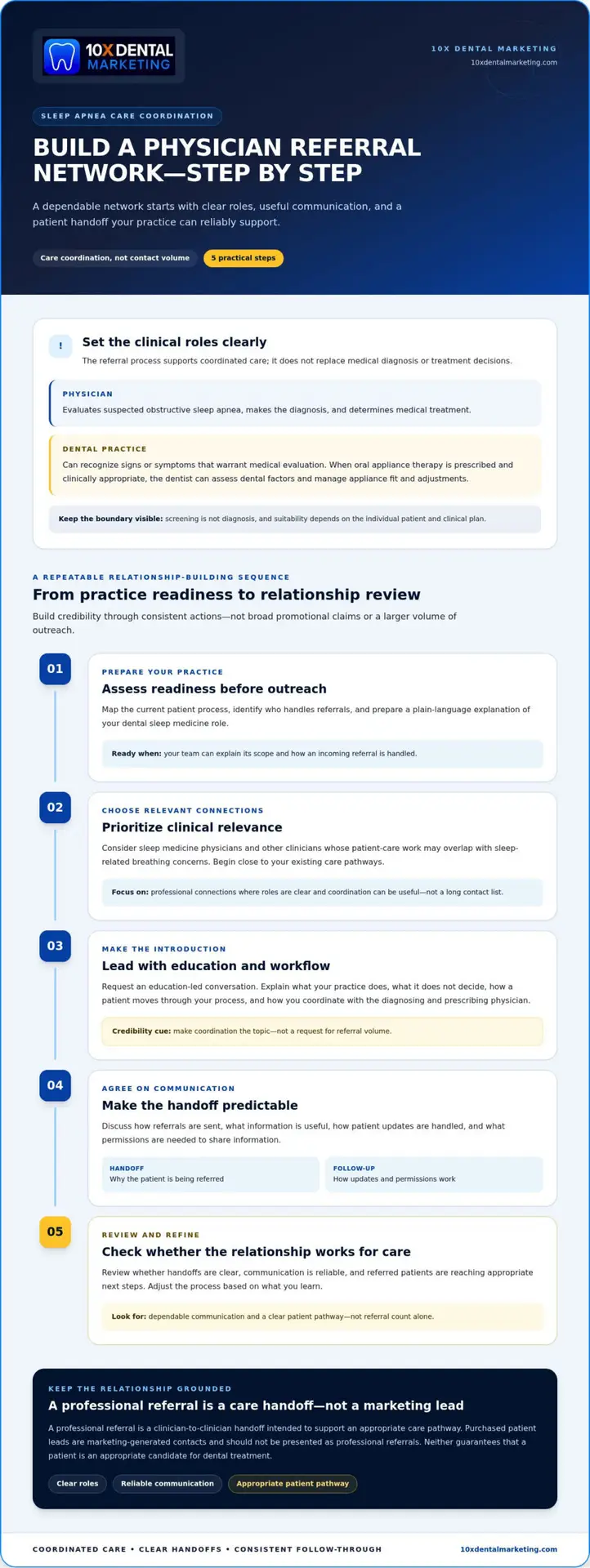
The goal isn’t to funnel every patient toward a dental appliance. It’s to help each patient reach an appropriate next step. A physician evaluates suspected OSA, makes the diagnosis, and determines medical treatment. A dental practice can recognize risk indicators, encourage medical evaluation, and, when appropriate, provide oral appliance therapy within a physician-directed care relationship. Referral relationships support coordination; they don’t replace physician diagnosis or treatment decisions.
What role can a dental practice play in sleep apnea care?
Dental teams may notice signs or symptoms that warrant discussion, but screening is not diagnosis. When a patient may have OSA, the practice can recommend evaluation by a physician rather than presenting a concern as a confirmed condition. If a physician diagnoses OSA and prescribes oral appliance therapy, the dentist can assess dental factors, plan and provide the appliance when appropriate, and manage its fit and adjustments. The physician remains responsible for medical decisions and assessing the patient’s OSA care. Suitability depends on the individual patient and clinical plan.
This distinction makes building physician referral networks for sleep apnea a care-coordination effort, not simply a practice-growth tactic. A useful handoff explains why the patient is being referred, what information is being shared, and how follow-up communication will work, with appropriate patient permission.
Why do physicians need confidence in a referral partner?
Confidence grows when a dental practice communicates its scope plainly, responds consistently, and makes the handoff predictable. A physician should be able to understand what happens after a referral: whether the patient schedules, attends a consultation, or needs another step. With appropriate authorization, concise updates can reduce uncertainty and help keep the care team aligned. Trust comes from repeatable actions, not broad promotional claims.
Professional referrals are clinician-to-clinician handoffs intended to support an appropriate care pathway; purchased patient leads are marketing-generated contacts and should not be presented as professional referrals. The distinction matters. A referral reflects a professional relationship and a reason to coordinate; a lead reflects a marketing interaction. Neither guarantees that a patient is an appropriate candidate for dental treatment. Clear roles, reliable communication, and sound clinical judgment make a network worth building.
How to Build Physician Referral Relationships for Sleep Apnea
Strong relationships start with readiness, not a mass email. Before building physician referral networks for sleep apnea, make sure your practice can explain its clinical scope, respond to incoming referrals, and communicate what happens after a patient arrives. Then develop professional connections step by step. Consistency matters more than contact volume.
- Assess readiness. Map your current patient process, identify who handles referrals, and prepare a plain-language explanation of your dental sleep medicine role.
- Identify relevant specialties. Consider sleep medicine physicians and other clinicians whose patient-care work may overlap with sleep-related breathing concerns. Begin with professional relationships close to your existing care pathways.
- Introduce the practice. Request an education-led conversation. Explain your scope, patient workflow, and how you coordinate with the diagnosing and prescribing physician.
- Agree on communication. Discuss how referrals are sent, what information is useful, how patient updates are handled, and what permissions are needed to share information.
- Review progress. Check whether handoffs are clear, communication is reliable, and referred patients are reaching appropriate next steps. Adjust the process based on what you learn.
In short: assess readiness, identify relevant clinicians, introduce your process, agree on communication, and review the relationship. This five-step sequence makes outreach repeatable without treating every contact as a referral source.
Which physician relationships should a dental practice prioritize?
Start with clinical relevance. Sleep medicine physicians are a natural group to consider, along with other clinicians who may encounter patients with sleep-related concerns. The right starting point depends on where patient-care needs genuinely intersect with your practice’s capabilities. A long contact list isn’t the objective. Focus on a manageable set of professional connections where roles are clear and coordination can be useful. No specialty guarantees referrals, and every relationship should be built around appropriate patient care.
How should the first conversation establish credibility?
Keep the introduction concise and specific. Explain what your practice does, what it doesn’t decide, how a patient moves through your process, and how the referring clinician can expect communication to work. Lead with coordination, not a request for referral volume. Describe the workflow your practice can support, use evidence-conscious language, and avoid promising clinical outcomes. A clear explanation gives a physician a reliable picture of what happens next.
Follow through on the details you agreed to. A short, relevant educational resource or process overview can reinforce the discussion, but it can’t replace direct communication. For practices building visibility alongside professional relationships, dental sleep medicine marketing can support clear positioning and educational content while leaving clinician-to-clinician trust at the center.
What Makes a Sleep Apnea Referral Partnership Worth Sustaining?
A busy referral channel isn’t automatically a strong one. A partnership is worth sustaining when it helps patients move through an appropriate care pathway and gives both practices confidence in the handoff. That standard is more useful than referral volume alone. Numbers can show activity, but they can’t tell you whether communication is clear, patients are reaching suitable consultations, or each clinician’s role is understood.
Look at what happens in practice. Does the physician understand which patients your dental practice is prepared to evaluate for oral appliance therapy? Does your team know what information to provide and how to communicate after the referral? Are questions handled reliably? These observable behaviors reveal relationship health more clearly than a promotional meeting or a growing contact list.
What signals a strong physician-practice fit?
Mutual fit starts with compatible patient-care needs and a realistic understanding of each practice’s capabilities. Confirm that referral criteria and next steps are clear to both teams. Then look for continuity: messages receive a response, handoffs follow the agreed process, and communication remains useful over time. Responsiveness supports trust, but it doesn’t guarantee referrals. Referral volume alone also doesn’t prove that a partnership is clinically appropriate.
- Shared understanding: Both teams can explain why a patient may be referred and what happens next.
- Clear boundaries: The physician’s and dentist’s responsibilities are distinct and respected.
- Reliable communication: Relevant updates and questions don’t disappear between offices.
- Patient-centered pathways: The process supports appropriate evaluation rather than pushing every patient toward one treatment.
How can a practice communicate value without overselling?
Keep the message specific. Describe the services your practice provides, how a patient moves through consultation and follow-up, and how you coordinate with the physician. Avoid claiming that an oral appliance cures sleep apnea or suits every patient. Treatment decisions depend on the individual and the broader care plan, so credible communication explains possibilities without promising a result.
Useful educational materials make that explanation easier to share. A concise overview of your role, patient pathway, and communication process can support professional dialogue without turning it into a sales pitch. Clear positioning also helps patients understand why a dental consultation may be part of coordinated care. For a broader look at how practice positioning supports visibility, explore this dental sleep medicine marketing strategy.
The strongest partnerships are maintained through consistent actions, not repeated asks. Review communication quality and whether the patient pathway remains appropriate. That’s how building physician referral networks for sleep apnea becomes an ongoing professional relationship rather than a short-term campaign.
How to Create a Reliable Referral and Follow-Up Workflow
A referral relationship only works if the handoff works. Map the patient journey from the moment a physician’s office sends a referral to the point when your practice completes the consultation, communicates an appropriate update, and records the next step. Make each stage visible. If ownership is unclear, referrals can stall between inboxes or remain unresolved without anyone noticing.
What should happen after a physician sends a referral?
Build a simple sequence your team can follow consistently:
- Receive and acknowledge: Use the communication channel agreed on with the referring office. Confirm receipt without sharing unnecessary patient details.
- Route the inquiry: Assign a team member to contact the patient and explain the next step. Record the referral source, date received, and current status in the practice’s chosen tracking system.
- Update the record: Track whether the patient was reached, scheduled, attended, or needs follow-up. Define each status so staff members record progress consistently.
- Close the loop: Share relevant updates with the referring physician when appropriate and authorized. Record what was sent and when.
Name an owner for intake, patient response, documentation, and physician updates. Set internal response expectations your team can meet, then review exceptions instead of letting delays disappear into a general queue. Use approved communication channels and follow your practice’s privacy procedures. Privacy requirements can depend on the information and circumstances, so verify applicable obligations with the person responsible for compliance before setting a process.
Which measures show whether the network is functioning?
Use a compact dashboard to monitor the process, not to make claims about clinical effectiveness. Track referral source, time from receipt to first response, consultations completed, and handoffs still unresolved. Document how your practice defines each measure. For example, decide what counts as a completed consultation and which event starts the response interval. Consistent definitions make trends easier to interpret.
Review patterns over time. A growing referral count may signal more activity, but it doesn’t prove patients are receiving appropriate care or that the workflow is reliable. Look for bottlenecks, such as referrals with no recorded follow-up, repeated delays, or unclear communication after a consultation. These signals point to process improvements your team can act on.
Operational data can also help practices understand how administrative processes support growth. Medical billing targeting for dental practices can complement that broader view; it doesn’t replace clinical coordination or referral tracking. For focused support with practice growth, explore dental sleep medicine marketing.
A defined workflow makes building physician referral networks for sleep apnea a trackable process, with clear ownership, consistent documentation, and patient-centered follow-through.
How Dental Sleep Medicine Marketing Can Strengthen Physician Networks
Marketing can make a well-run referral process easier to understand and reinforce. It can’t replace the direct conversations that build professional trust. A practice website, patient education, and physician-facing materials should all describe the same scope and patient pathway. If the website promises more than the team can deliver, it creates confusion. When messaging matches the actual workflow, it gives patients and clinicians a clearer picture of what to expect.
How can practice marketing support professional trust?
Start with clear positioning. Explain what a dental sleep medicine consultation involves, how patients may enter the care pathway, and how the practice coordinates with physicians. Keep educational content informative, not diagnostic. It should help patients understand the purpose of a consultation without suggesting that every person with sleep concerns needs dental treatment. Physician-facing materials should reflect the process your team follows after a referral arrives.
Consistency matters. A physician who receives a concise, accurate overview should see the same scope reflected on the website and in follow-up communication. Educational content can answer basic questions before a patient calls, while direct clinician-to-clinician communication handles individual care coordination. Together, these tools support understanding without substituting for the professional relationship.
What should a practice improve before scaling outreach?
Build capacity before increasing activity. Confirm that referral intake has a clear owner, follow-up responsibilities are assigned, and referral sources and consultation status are recorded consistently. Then connect marketing reports to useful practice measures, such as inquiries received, consultations scheduled, and unresolved handoffs. Define each measure and review it over time. More leads or referrals alone don’t prove care quality, partnership strength, or clinical results.
10X Dental Marketing supports dental sleep medicine practices with specialized marketing and lead generation. These growth tools can complement professional referrals, not replace physician relationships or clinical judgment. AI-driven lead generation can serve as a separate patient acquisition channel alongside a dependable referral workflow.
For practices building physician referral networks for sleep apnea, the practical sequence is clear: align messaging with your actual process, strengthen intake and follow-up, track useful measures, then expand outreach with purpose. Explore AI-driven lead generation as one part of a coordinated growth approach.
Turn Stronger Relationships Into a Repeatable Growth System
Effective physician networks aren’t built on outreach alone. They rely on clear roles, dependable patient handoffs, and communication that helps both practices coordinate appropriate care. Track referral sources, consultation progress, and unresolved follow-ups to identify where the process needs attention. Referral volume matters, but it can’t stand in for care quality or prove clinical outcomes.
Building physician referral networks for sleep apnea takes consistent relationship work, supported by a workflow that can handle each connection well. Clear positioning and useful educational content can reinforce physician confidence, while specialized dental sleep medicine marketing helps practices strengthen visibility. 10X Dental Marketing also provides AI-driven lead generation, medical billing targeting, and brand development, with an executive team experienced in nationally recognized Dental Support Organizations.
Keep the focus on reliable systems and patient-centered coordination. Build a stronger dental sleep medicine growth system with marketing support designed for this specialized field. Start with a clear process, strengthen it over time, and give every professional relationship room to grow.
Frequently Asked Questions
How can a dental practice get physician referrals for sleep apnea?
Earn physician referrals by making collaboration clear, useful, and dependable. Prepare a concise explanation of your dental sleep medicine scope, patient pathway, and communication process. Introduce the practice through education-led professional conversations, then follow through consistently when a referral arrives. Building physician referral networks for sleep apnea takes ongoing relationship work, not just outreach. Track whether patients are reached, consultations are completed, and handoffs are resolved, without treating referral volume as proof of clinical quality.
Which physicians can refer patients for dental sleep apnea care?
Sleep medicine physicians are a natural group to consider, along with other physicians whose patients may have sleep-related concerns, such as primary care clinicians. The right professional connection depends on shared patient-care needs and a clear understanding of each practice’s role. A referral doesn’t automatically make someone a candidate for dental treatment. The physician evaluates and diagnoses suspected obstructive sleep apnea, while a dentist may provide oral appliance therapy when prescribed and clinically appropriate.
What should a physician referral program include?
A useful program defines how referrals are received, acknowledged, routed, documented, and followed up. Assign ownership for intake and physician updates, and agree on how the practices will communicate. Track referral source, response interval, consultation status, and unresolved handoffs using consistent definitions. Include privacy-conscious procedures for sharing patient information and verify applicable requirements with the person responsible for compliance. Review the workflow regularly so gaps are identified and corrected rather than becoming routine.
How do you build trust with physicians as a dental sleep medicine practice?
Build trust through clear scope, predictable handoffs, and responsive communication. Explain what your practice can contribute, how patients move through the consultation process, and when the referring physician can expect relevant updates, with appropriate patient authorization. Use educational materials to clarify your role, not to promise that an oral appliance will cure sleep apnea or suit everyone. Reliable follow-through earns credibility more effectively than promotional claims or requests for referral quotas.
How should a dental practice measure physician referral relationships?
Track the process from referral receipt through patient contact, scheduled and completed consultations, and appropriate follow-up. Record referral sources and response intervals, and flag handoffs that remain unresolved. Define each measure so staff record it consistently, then review patterns over time. Referral counts show activity, not care quality or treatment effectiveness. Pair volume data with communication and workflow indicators, such as whether updates were sent as agreed and whether referrals reached an appropriate next step.
Can marketing replace physician outreach for sleep apnea referrals?
No. Marketing can support practice visibility and help patients and physicians understand the practice’s scope, but it can’t replace direct professional relationships or coordinated care. Clear website messaging and educational content should match the actual patient pathway and referral process. Specialized dental sleep medicine marketing and lead generation can complement clinician outreach, while AI-driven lead generation supports a separate patient acquisition channel. Keep each channel distinct, and evaluate both with meaningful practice-level measures rather than assumed outcomes.