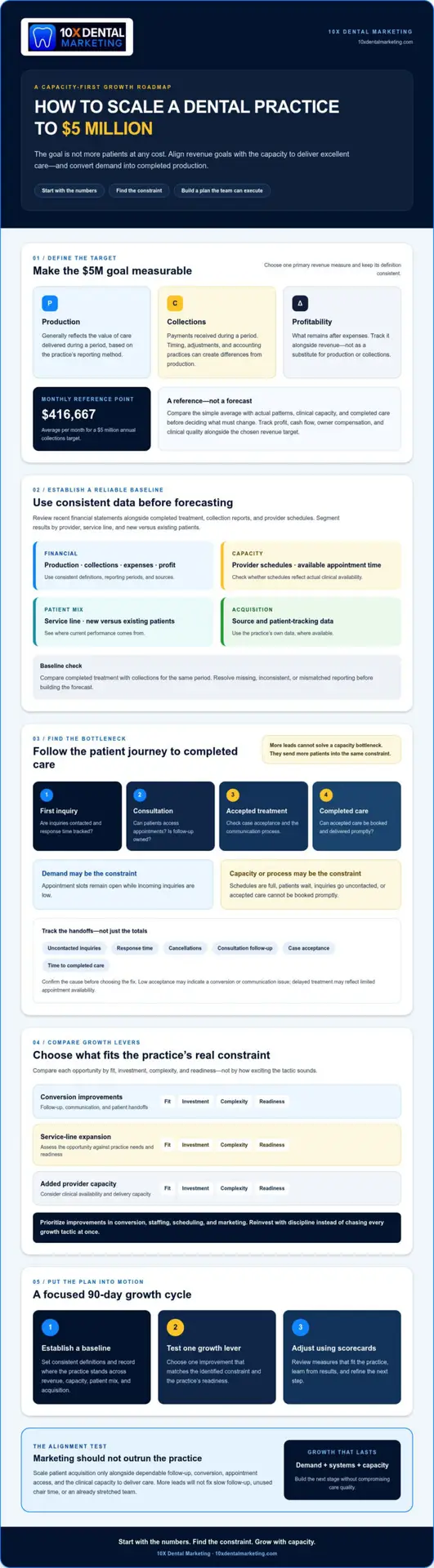
A $5 million dental practice isn’t built by cramming more patients into an already strained schedule. The real challenge in how to scale a dental practice to 5 million is aligning the revenue target with the capacity to deliver excellent care and convert demand into production. More leads won’t fix slow follow-up, unused chair time, or a team that’s already stretched thin.
Sustainable growth depends on knowing what must change, and in what order. This roadmap shows you how to translate the target into measurable production and patient goals, identify bottlenecks, and prioritize improvements in conversion, staffing, scheduling, and marketing. You’ll also learn how to assess service-line opportunities and reinvest with discipline instead of chasing every growth tactic at once.
The goal isn’t growth at any cost. It’s a stronger practice with the capacity, systems, and patient demand to support its next stage. Start with the numbers. Find the constraint. Then build a growth plan your team can execute without compromising care quality.
Key Takeaways
- Define whether your $5 million target means production, collections, or another measure, then track profitability and care quality alongside revenue.
- Map the patient journey to find where demand is lost, and check appointment capacity before increasing lead volume.
- Compare conversion improvements, service-line expansion, and added provider capacity by fit, investment, complexity, and readiness.
- Use a 90-day plan to establish a baseline, test one growth lever, and adjust based on measures that fit your practice.
- Learn how to scale a dental practice to 5 million by aligning targeted patient acquisition with follow-up, conversion, and the capacity to deliver care.
Scale to $5M: Define Targets Before Chasing Growth
A $5 million goal sounds clear until the team asks what the number actually measures. Production, collections, and profit describe different outcomes. Choose the wrong target and the practice can appear to grow while cash flow tightens, owner compensation stalls, or patient care is strained.
Production and collections measure different points in the financial process, while profitability measures what remains after expenses. They’re connected, but they aren’t interchangeable. Decide whether your goal is annual production or annual collections, document the reporting period and accounting definitions, then track profit, cash flow, owner compensation, and clinical quality alongside it. These are core practice management principles, not optional details.
Which number should a dental practice scale: production or collections?
Production generally reflects the value of care delivered during a period, based on the practice’s reporting method. Collections reflect payments received during that period. Timing, adjustments, and accounting practices can create differences between the two, so don’t treat one as a substitute for the other. Select one primary target and use the same definition consistently. Confirm how the practice records each measure with its accountant.
How to turn a $5 million goal into a measurable baseline
Before forecasting, establish what the practice produces and collects now. Review recent financial statements alongside completed treatment, collection reports, and provider schedules. Then segment results by provider, service line, and new versus existing patients. This shows where current performance comes from and gives the owner a grounded starting point for deciding how to scale a dental practice to 5 million.
Build a baseline the team can check regularly. Record the reporting period and source for each measure, then flag missing or inconsistent data before setting targets. For example, compare completed treatment with collections for the same period, and check whether provider schedules reflect actual clinical availability. If reports use different definitions or time frames, resolve that first. A forecast built on mismatched numbers creates false confidence, not a reliable growth plan.
- Financial: production, collections, expenses, and profit, using consistent definitions.
- Capacity: provider schedules and available appointment time.
- Patient mix: results by service line and new versus existing patients.
- Acquisition: the practice’s own source and patient-tracking data, where available.
Once the baseline is consistent, translate the annual goal into smaller reporting checkpoints. A $5 million annual collections target averages about $416,667 per month, but that simple average is a reference point, not a forecast. Compare it with the practice’s actual patterns, capacity, and completed care before deciding what must change.
Find the Bottleneck: Match Dental Practice Demand to Clinical Capacity
More inquiries don’t automatically create more completed care. If patients can’t get appointments, calls go unanswered, or treatment plans stall without follow-up, adding demand can magnify the breakdown. More leads cannot solve a capacity bottleneck; they only send more patients into the same constraint.
Map the patient journey from first inquiry to scheduled consultation, accepted treatment, and completed care. At each step, identify who owns the next action and what the practice records. This reveals whether growth is limited by insufficient demand or by gaps in access, response, follow-up, or clinical availability.
How to tell whether demand or capacity is limiting growth
Start with the schedule. Review appointment availability, utilization, and wait times by provider and visit type. Then compare those patterns with incoming inquiries and cancellations. If appointment slots remain open while inquiries are low, demand may be the constraint. If schedules are full but patients wait, inquiries go uncontacted, or accepted care cannot be booked promptly, investigate capacity and process before investing in more lead volume.
Track the handoffs, not just the totals. Use the practice’s own data to measure uncontacted inquiries, response time, cancellations, consultation follow-up, case acceptance, and the time between acceptance and completed care. A low acceptance rate may point to a conversion or communication issue; delayed treatment may instead reflect limited appointment availability. Confirm the cause before choosing the fix. The ADA practice management resources can provide additional context for practice operations.
Build an operating model before adding volume
Growth needs clear ownership. Document who handles incoming inquiries, schedules consultations, follows up on proposed treatment, manages clinical scheduling, and monitors performance. Define what information moves between the front desk, treatment coordination, clinicians, and management, and when the next person is expected to act. Consistent workflows reduce the chance that patient handoffs depend on memory or individual workarounds.
Then assess whether the practice can support more activity without compromising access or the patient experience. Review staffing, training, chair time, and space with qualified practice leaders. Don’t assume every constraint requires a new hire or expansion; first determine whether existing schedules and workflows are being used effectively.
Increase acquisition only when the practice can respond to, schedule, and care for the patients it seeks to attract. If capacity is ready and qualified demand is the gap, targeted patient acquisition may be one lever in the plan. Learn more about AI-driven lead generation as a marketing option, while keeping in mind that results also depend on the practice’s follow-up, conversion, and care capacity.
Compare Dental Practice Growth Levers by Fit, Risk, and Readiness
There’s no universal best move. A practice losing prospective patients during follow-up has a different constraint from one with full schedules but limited provider capacity. To decide how to scale a dental practice to 5 million, compare each growth lever with the verified bottleneck, the resources it requires, and the practice’s ability to measure results.
Use this framework to evaluate options before committing. Potential upside is specific to each practice, not a promised outcome.
| Growth lever | Prerequisites | Potential upside | Risks | Measures to validate locally |
|---|---|---|---|---|
| Improve existing-patient conversion | Reliable inquiry tracking, consistent follow-up, and clear treatment communication | Make better use of current patient demand and practice capacity | More inquiries won’t help if access, follow-up, or appointment availability remains constrained | Inquiry response, consultation attendance, case acceptance, and completed treatment |
| Expand or deepen a service line | Clinical expertise, appropriate patient demand, scheduling capacity, and follow-up resources | Serve a relevant patient need and develop a distinct source of production | Added complexity, training needs, or demand that exceeds the practice’s ability to deliver care | Qualified inquiries, consultations, treatment completion, schedule impact, and financial results |
| Add provider capacity | Evidence that clinical availability is limiting growth, plus a plan for staffing and onboarding | Increase the practice’s ability to deliver care when demand is ready | Added operational demands without enough appropriate patient demand or workflow support | Provider schedule utilization, appointment availability, wait times, and completed care |
When should a practice deepen existing services or add a specialty?
Start with clinical appropriateness and readiness, not market appeal alone. Assess provider expertise, documented patient demand, scheduling capacity, and the team’s ability to coordinate follow-up. Full-arch implants or dental sleep medicine may be options to evaluate when they fit the practice’s clinical scope and operational capabilities. For marketing context, review full-arch implant marketing; marketing information isn’t clinical advice.
When does targeted patient acquisition belong in the growth plan?
Use acquisition when the practice can define which patients it can appropriately serve and has the capacity to respond, schedule, and follow through. Connect each source to consultation outcomes and completed treatment, not just inquiry volume. This makes it possible to assess whether a channel is attracting suitable demand. Medical billing targeting for dental is one approach to evaluate against practice-specific criteria.
Choose the lever that addresses a verified constraint. Test it, measure the operational and financial effects, then adjust. Fit first. Readiness next. Investment follows.
Create a 90-Day Dental Practice Growth Plan With Clear Scorecards
A 90-day pilot turns a growth idea into a decision backed by practice data. Keep the scope tight: select one constraint, test one growth lever, and agree in advance how the team will judge progress. This makes the path to how to scale a dental practice to 5 million measurable without confusing activity with results.
Use this sequence to build the plan:
- 1. Baseline: Record the current figures, reporting periods, and definitions for inquiries, scheduling, completed care, collections, and staffing inputs.
- 2. Bottleneck: Identify the point where patients or capacity are being lost, using the practice’s own journey and schedule data.
- 3. Selected lever: Choose an action that addresses that constraint, such as improving follow-up or testing targeted acquisition.
- 4. Pilot: Assign an owner, document the workflow, and set review dates before launch.
- 5. Measurement: Compare leading indicators, which show whether the process is working, with lagging indicators that reflect completed care and financial outcomes.
- 6. Adjustment: Decide whether to scale, revise, or stop based on the agreed criteria and operational impact.
Review marketing, scheduling, staffing, and financial signals in a consistent management meeting. Keep the scorecard focused so the decision that matters doesn’t get lost in a long dashboard.
What should a dental practice measure during a growth pilot?
Track inquiry quality, contact rate, consultation attendance, and treatment acceptance as leading indicators. Then follow completed care and collections alongside the campaign and staffing inputs associated with the pilot. Confirm that marketing, scheduling, and finance teams use the same definitions and reporting periods. Otherwise, apparent gains may reflect mismatched records rather than better performance.
How should leaders decide whether to scale, revise, or stop?
Set review dates and decision criteria before the pilot begins. Scale only if demand is appropriate, clinical capacity can support it, and the patient experience remains sound. If inquiries rise but consultations don’t happen, investigate follow-up and access. If treatment is accepted but care cannot be scheduled, address capacity before increasing spend. A weak result is a signal to diagnose, not a reason to pour more volume into the same process.
Practices evaluating patient acquisition can consider AI dental lead generation as one option within a wider growth plan. A strategy discussion can help assess whether it fits the practice’s goals and readiness. Marketing can support a growth plan, but it can’t guarantee a revenue outcome.
Scale Patient Acquisition Without Letting Marketing Outrun the Practice
Marketing can bring the right opportunity to the door. It can’t create appointment availability, earn patient trust, or complete follow-up on its own. Sustainable acquisition depends on the whole path: access, clear communication, timely response, appropriate consultations, and the capacity to deliver care. That connection matters when deciding how to scale a dental practice to 5 million. More activity is not progress if the practice can’t turn it into completed patient care.
Broad awareness campaigns and specialized, high-intent acquisition serve different purposes. Awareness may build recognition over time, while focused campaigns aim to reach people seeking a particular service. Don’t judge either approach by impressions or inquiry volume alone. Compare lead quality, response, consultation attendance, treatment decisions, completed care, and collections using consistent practice data. The right mix depends on the services offered, available capacity, and the outcomes the practice needs to improve.
How to connect marketing leads to completed patient care
Define lead stages before launch, such as inquiry received, contacted, consultation scheduled, consultation attended, treatment decision recorded, and care completed. Require consistent source tracking in the practice system, then review progression through each stage. If inquiries arrive but consultations don’t happen, examine contact and scheduling workflows. If consultations occur but treatment doesn’t proceed, review the relevant patient experience and follow-up process.
Link marketing and front-office workflows without sharing more patient information than needed for the task. Establish who can access shared information, how sources are recorded, and how performance reports are assembled. Discuss applicable privacy and data-handling responsibilities with qualified advisors; don’t assume a vendor’s tools or claims resolve them automatically.
What to evaluate in a specialized dental marketing partner
Ask how the partner defines a qualified lead, what outcomes its reporting follows, and how it connects campaign activity with consultation and completed-care data. Look for relevant experience with the practice’s services and ask how the proposed approach accounts for team readiness and clinical capacity. A polished lead report isn’t enough if it stops before patient outcomes.
For AI-driven lead generation or medical billing targeting, ask what data is used, how targeting decisions are made, what information is shared, and how privacy and compliance questions are addressed. Request clear explanations rather than broad assurances. Marketing can support acquisition, but it can’t guarantee revenue; the practice’s access, follow-up, conversion, and care delivery remain essential.
When your practice is ready to evaluate acquisition against its goals and capacity, learn about dental growth strategy options from 10X Dental Marketing. Assess fit, measurement, and the role marketing could play in the wider growth plan.
Turn Your Growth Target Into the Next Measurable Move
A $5 million goal needs more than ambition. Define the number you’re pursuing, identify the constraint that’s slowing progress, and choose a growth lever your team can support. Then test it against clear measures, from patient inquiries and consultation outcomes to completed care and financial results.
That’s the practical answer to how to scale a dental practice to 5 million: align acquisition with conversion and clinical capacity, then adjust based on what your own data shows. Marketing can strengthen that system, but it can’t guarantee a revenue outcome.
10X Dental Marketing specializes in full-arch implant and dental sleep medicine marketing, with AI-driven lead generation and medical billing targeting. Its leadership team also brings experience with nationally recognized Dental Support Organizations. If patient acquisition is the lever your practice is ready to evaluate, build a stronger dental growth strategy with 10X Dental Marketing.
Set the target. Fix the constraint. Measure the next move. With a disciplined plan and a team ready to deliver, your practice can pursue growth without losing sight of profitability or patient care.
Frequently Asked Questions
Can a dental practice realistically reach $5 million in annual revenue?
Yes, some practices may be able to reach that level, but it isn’t a guaranteed outcome or a target every practice can pursue the same way. The path depends on the current revenue baseline, provider and appointment capacity, patient demand, conversion, service mix, and operating costs. Define whether $5 million means production or collections, then assess the growth required against profitability, cash flow, and the practice’s ability to maintain quality care.
How many patients does a dental practice need to reach $5 million?
There’s no reliable patient count without knowing the practice’s annual revenue per patient and service mix. A practice focused on different procedures may generate very different revenue from the same number of patients. As a planning exercise, divide the annual revenue target by the practice’s own average annual revenue per patient, using a consistent reporting period and accounting definition. Treat the result as an estimate, then test it against appointment capacity and completed-care data.
How long does it take to scale a dental practice to $5 million?
There’s no universal timeline. The time required depends on the gap between current performance and the target, as well as the practice’s capacity, staffing, patient conversion, and chosen growth levers. To plan how to scale a dental practice to 5 million, set a baseline, identify the main constraint, and use short pilots with scheduled reviews. Update the forecast as real results emerge instead of assuming a fixed growth rate or deadline.
What is the most important metric when scaling a dental practice?
Start with the primary target you’ve defined: production or collections, measured consistently over a clear period. Neither figure alone shows whether growth is healthy. Pair it with completed care, profitability, cash flow, capacity, and patient-conversion measures so the team can see what drives the result and whether the practice can sustain it. The most useful scorecard reflects the practice’s actual constraint, rather than relying on a generic benchmark.
Should a dental practice hire more staff before increasing marketing?
Not automatically. First determine whether staffing is the bottleneck. Review appointment availability, schedule utilization, inquiry response, wait times, and follow-up. If current demand is being lost because the team can’t respond or schedule patients effectively, address that constraint before driving more inquiries. If the schedule has room and the team can manage additional patient flow, marketing may be appropriate. Assess hiring and training needs with qualified practice leaders.
Can specialized dental marketing help a practice reach $5 million?
Specialized dental marketing can support patient acquisition, but it can’t guarantee a revenue target. Results also depend on whether inquiries match the practice’s services, how promptly the team responds, consultation attendance, treatment decisions, and the capacity to complete care. Evaluate campaigns using consistent source tracking and follow leads through to completed treatment and collections. Consider marketing as one lever in a broader growth plan, not a substitute for operational readiness.
Is adding dental implants enough to scale a practice to $5 million?
No. Adding an implant service line alone doesn’t ensure the practice will reach a revenue target. Growth depends on clinical expertise and appropriateness, patient demand, scheduling capacity, patient communication, and follow-through from consultation to completed care. Practice leaders should assess these factors before deciding whether to expand a service line. Marketing may help attract relevant inquiries, but it doesn’t replace clinical judgment or the systems needed to deliver care well.