A dental implant ad can attract clicks and still fail to produce a qualified consultation. If you’re asking, “why my dental implant ads are not working,” the problem may not be the ad itself. The breakdown could be in targeting, the landing page, tracking, or the way your team handles inquiries.
It’s frustrating to spend on campaigns without knowing whether inquiries are a good fit or where prospective patients drop off. Clicks and raw lead totals can make a campaign look active while the patient-acquisition process stalls. More traffic won’t fix a broken handoff.
This guide will help you find where your dental implant campaigns are losing potential patients and decide which fixes to tackle first. You’ll learn how to review targeting and creative, check the landing-page experience, verify tracking, and assess follow-up. Measure performance by meaningful milestones, such as qualified inquiries and booked consultations, rather than relying on clicks alone. Find the break, prioritize the fix, and build a clearer path from ad response to consultation.
Key Takeaways
- To diagnose why my dental implant ads are not working, trace the patient journey from ad visibility and engagement through booking, attendance, and documented treatment outcomes.
- Check whether each channel, audience, and ad message matches the implant service and the intent of prospective patients.
- Assess lead quality by contactability, treatment interest, and documented next steps, not by inquiry totals alone.
- Audit measurement first, then test one meaningful campaign change at a time and record the result.
- Fix isolated tracking, landing-page, or follow-up issues directly. Consider a broader review when problems persist across channels.
Why Dental Implant Ads Stop Working: Find the First Broken Metric
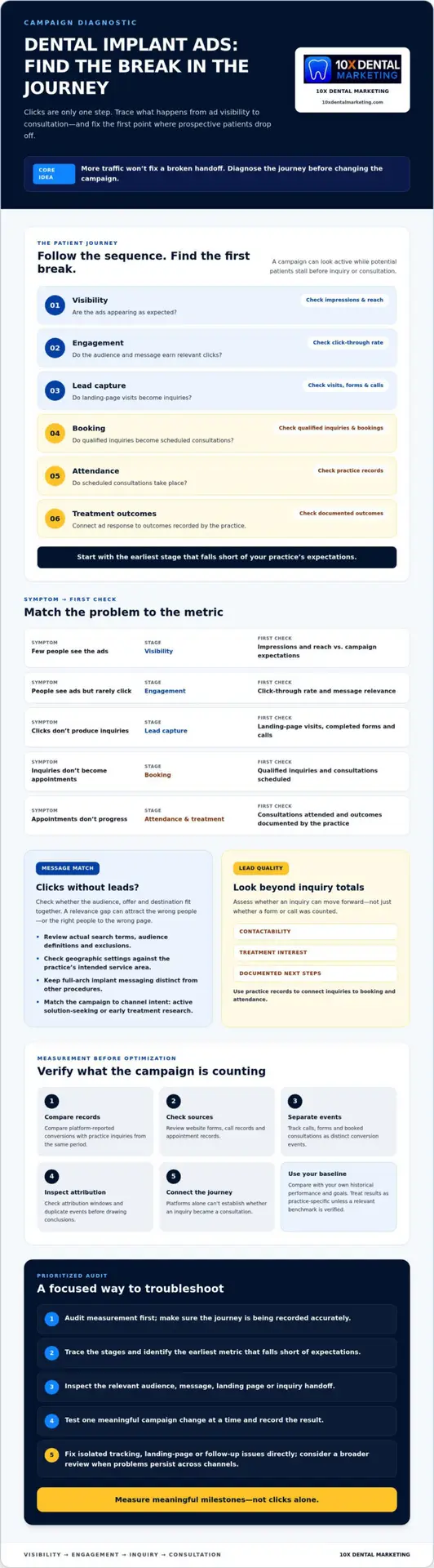
Spending on dental implant ads without getting enough qualified, booked consultations is frustrating. But “the campaign isn’t working” is too broad to act on. To answer why my dental implant ads are not working, trace the patient journey stage by stage and identify the first point where results fall short of your practice’s expectations.
Separate the journey into visibility, engagement, lead capture, appointment booking, attendance, and documented treatment outcomes. Ads can earn impressions and clicks while losing prospective patients before they submit an inquiry. Or a campaign may generate inquiries that never become consultations. Each point of failure calls for a different investigation.
| Symptom | Stage to inspect | First metric or record to check |
|---|---|---|
| Few people see the ads | Visibility | Impressions and reach, compared with campaign expectations |
| People see ads but rarely click | Engagement | Click-through rate and the relevance of the message |
| Clicks don’t produce inquiries | Lead capture | Landing-page visits, completed forms, and calls |
| Inquiries don’t become appointments | Booking | Qualified inquiries and consultations scheduled |
| Appointments don’t progress | Attendance and treatment | Consultations attended and documented treatment outcomes, as recorded by the practice |
Use your own historical performance and goals as the baseline. Unless a benchmark has been verified for a relevant comparison, treat it as practice-specific rather than a universal standard.
Are the ads failing, or is the campaign simply hard to measure?
Before changing creative or targeting, compare platform-reported conversions with the inquiries your practice actually received during the same period. Check website forms, call records, and appointment records. A mismatch may point to tracking gaps, duplicate reporting, or different attribution settings. Set up distinct conversion events for calls, forms, and booked consultations so an inquiry is not mistaken for a scheduled visit.
Check for inconsistent attribution windows and duplicate events before drawing conclusions. Otherwise, one patient action may be counted more than once, or a platform may report a conversion that doesn’t match an inquiry recorded by the practice.
Which numbers reveal where prospective implant patients drop off?
Read the metrics in sequence. Impressions show whether ads are appearing; click-through rate helps assess whether the message earns engagement. Compare landing-page visits with completed forms, calls, and qualified inquiries. Then use practice records to connect each inquiry to booking and attendance. That final connection matters because ad platforms alone can’t establish whether an inquiry became a consultation.
When reviewing implant messaging, credible context can help patients understand the treatment. For background, see this overview of the history of modern dental implants. Keep the diagnosis focused: identify the earliest broken metric, then investigate that stage before changing the rest of the campaign.
Dental Implant Ad Clicks Without Leads? Audit Targeting and Message Match
Clicks without inquiries often point to a relevance gap. The ad may reach people outside the intended audience, promote a different treatment from the one described on the landing page, or attract early-stage researchers when the campaign is designed to generate consultation inquiries. To understand why my dental implant ads are not working, assess the audience, offer, and destination as one connected path.
Does the ad reach people looking for the implant treatment you offer?
Start with the actual search terms, audience definitions, exclusions, and geographic settings. Look for broad or unrelated queries, settings that extend beyond the practice’s intended service area, and audiences that don’t match the treatment being promoted. Keep full-arch implant messaging distinct from other procedures so you can see which offer is attracting clicks.
Account for channel intent, too. Search often captures people actively looking for a solution, while social advertising can introduce a treatment to people who are still learning. Compare results with each channel’s role. Are visitors researching treatment options, looking for eligibility information, or signaling interest in a consultation? Targeting can focus a campaign, but it can’t establish clinical eligibility, insurance coverage, or case acceptance. Those require appropriate evaluation and confirmation.
Does the landing page deliver the promise made in the ad?
Match the ad’s wording to the page’s headline, treatment description, eligibility language, and call to action. If an ad promotes full-arch implants but sends visitors to a general page about all dental services, they have to work to confirm they’re in the right place. That extra effort can weaken response. Review the page on mobile as well: check that it loads and reads clearly, the form asks only for necessary information, and contact options are easy to find.
Keep claims accurate and supportable. If promotional copy discusses a specific medical device, consult FDA’s definition of labeling as a reference point. Don’t assume every claim or context is appropriate. Review platform policies and applicable requirements before publishing.
For a broader look at how treatment focus and campaign structure fit together, explore this full-arch implant marketing strategy. If full-arch targeting is the diagnosed gap, a specialist in full-arch implant marketing may help your practice assess its campaign approach.
Why Dental Implant Leads Do Not Become Consultations: Check Quality and Follow-Up
A high lead count can hide a weak pipeline. A form submission doesn’t confirm that someone is reachable, interested in the implant treatment offered, clinically appropriate, or booked for a consultation. To understand why my dental implant ads are not working, follow each inquiry from its source through response, contact, qualification, scheduling, attendance, and a documented next step.
How can a practice tell whether implant leads are genuinely qualified?
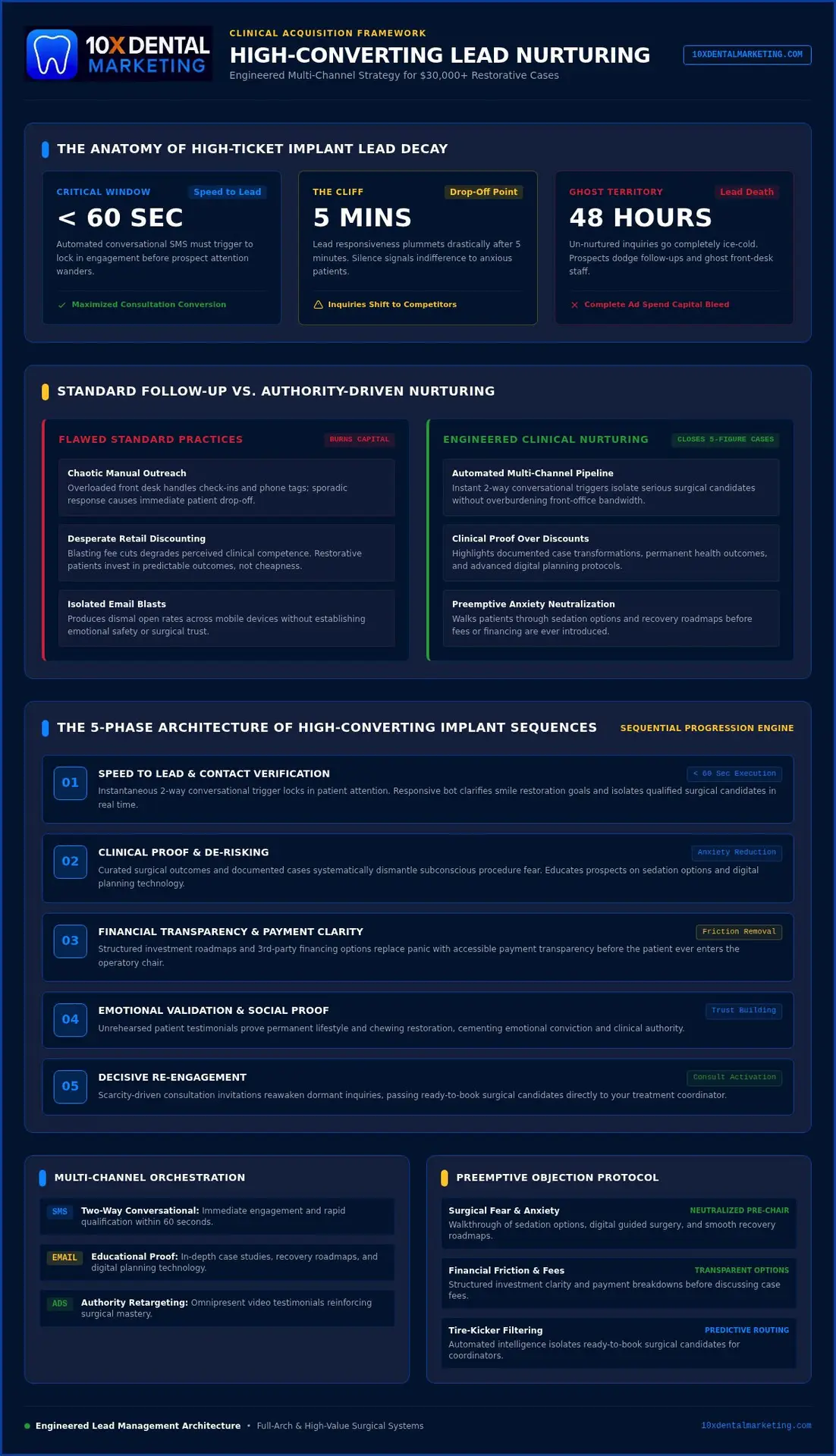
Agree on a written definition of a qualified inquiry with the marketing and practice teams. Keep it practical: record the inquiry source, the person’s stated treatment interest, whether the practice could make contact, and the appointment outcome. Then review a sample of inquiries against that definition. A platform form submission is a lead record, not confirmation that someone is a treatment candidate or has accepted care.
Use consistent statuses so inquiries don’t disappear into a vague “contacted” category. For example, distinguish “unable to reach,” “seeking different treatment,” “consultation scheduled,” and “not a clinical fit after evaluation.” These statuses help reveal whether the campaign attracts the wrong inquiries or qualified prospects are dropping out later.
Is the follow-up process losing people after they inquire?
Audit response-time records, missed calls, unanswered forms, and documented contact attempts. Check whether staff explain the next step clearly and follow a consistent scheduling process. If inquiries are relevant but contact attempts aren’t completed or appointments aren’t offered clearly, the bottleneck may be staffing or scheduling rather than ad targeting.
Separate possible causes before changing the campaign. The issue might be mismatched expectations set by the ad, difficulty reaching the person, limited appointment options, unclear financing communication, or a clinical-fit decision. Financing details and clinical suitability should be handled accurately by the practice; advertising data cannot establish either. Record why an inquiry doesn’t progress and look for recurring patterns rather than assuming every unbooked lead is poor quality.
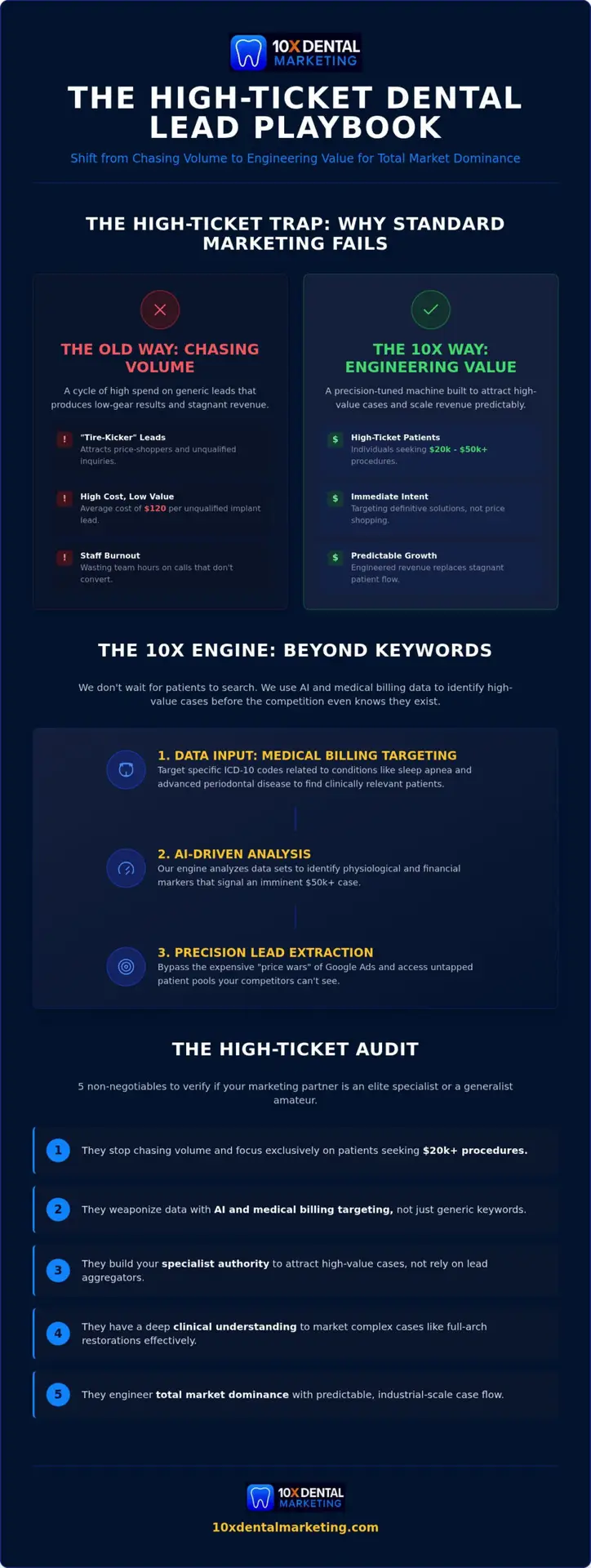
Medical billing targeting may be one possible audience strategy, but it isn’t a shortcut to identifying eligible patients. Before using any data for advertising, verify its source, permissions, privacy safeguards, and applicable requirements. Assess the approach both for responsible data use and for whether it contributes to relevant inquiries. For additional context, review this overview of medical billing targeting for dental acquisition.
Close the loop with a documented outcome for every inquiry. When the practice and marketing team can distinguish an audience mismatch from a follow-up gap, they can address the right part of the acquisition process instead of making broad campaign changes without evidence.
How to Troubleshoot Dental Implant Ads: A Prioritized Campaign Audit
When you’re asking why my dental implant ads are not working, resist the urge to change the audience, rewrite the ads, and rebuild the landing page all at once. Start with the evidence. A prioritized audit helps isolate the failure point and makes each adjustment easier to evaluate.
- Verify measurement first. Confirm the campaign objective and which conversion events are counted. Check that calls, forms, and booked consultations are distinguishable, call tracking works as intended, and source attribution is consistent. Reconcile platform reports with website inquiries and practice records before interpreting lead performance. If the counts don’t align, investigate the discrepancy before optimizing.
- Review the audience and traffic. Inspect search terms or audience settings, exclusions, and geographic targeting. Compare the ad with the implant service being promoted and the page visitors reach. Look for irrelevant searches, overly broad audiences, or mixed treatment offers that make results difficult to interpret.
- Check the landing-page journey. Confirm that the page delivers the promise made in the ad. Review clarity, mobile usability, form friction, and whether prospective patients can identify the next step. Don’t change targeting to compensate for a page that fails to explain the offer.
- Trace outcomes beyond the click. Compare channels and campaigns by impressions, engagement, landing-page visits, inquiries, qualified inquiries, booked consultations, and attendance. Use consistent definitions and comparable reporting periods where possible. Benchmarks aren’t universal; interpret results against your practice’s goals, historical performance, and the quality of actual outcomes.
- Test one meaningful change. Choose a single variable, such as the ad message, audience settings, landing-page clarity, or form friction. Before launching, document the change, set a review date, and decide what evidence would support keeping, revising, or reversing it. Avoid changing several variables at once, since you may not be able to tell what drove the result.
Data-informed optimization depends on reliable inputs and careful interpretation. This overview of AI dental lead generation strategies offers additional context for evaluating how data can inform campaign decisions. Before implementing changes, verify current platform policies, privacy requirements, and applicable advertising rules. Healthcare-related restrictions can change, so review a campaign against the requirements relevant to its platform and content.
If the audit shows persistent gaps across targeting, measurement, and lead outcomes, explore specialist implant campaign support as a possible next step. Base the decision on the diagnosed bottleneck, not clicks alone.
When to Rebuild Dental Implant Ads or Get Specialist Help
A campaign doesn’t need a full reset every time results dip. If tracking is reliable and the problem is isolated, such as a confusing landing page or inconsistent follow-up, fix that weakness and measure what changes. If targeting, measurement, the offer, and the patient journey repeatedly fall short across channels, a broader review may be needed. Match the response to the diagnosed problem rather than rebuilding by default.
Should you optimize the existing campaign or start over?
Keep an existing campaign under review when its data is dependable and you can identify a fixable bottleneck. A rebuild may make sense when the offer is unclear, the intended audience is poorly defined, conversion tracking can’t be trusted, or the path from ad to consultation lacks a coherent structure. Before approving a reset, ask for a written rationale, a clear measurement plan, and agreement on what evidence will show whether the new approach is working.
Choose support based on the work the practice can manage consistently. Internal management may fit when someone has the time and skills to monitor the campaign, interpret meaningful outcomes, and coordinate changes with the practice team. Generalist marketing support may suit broader needs, but ask about specific experience with high-consideration implant campaigns. An implant specialist should be able to explain its approach to treatment-specific messaging and how it evaluates performance beyond raw lead totals. In every case, confirm responsibilities, communication, and how decisions will be documented.
What should a dental implant marketing partner be accountable for?
Ask how reporting connects advertising activity to qualified inquiries and consultations, and how the team distinguishes a tracking issue from a campaign or follow-up problem. Clarify who owns landing pages, tracking setup, lead routing, and optimization decisions. The practice still needs to define lead qualification and record appointment outcomes; an advertising report alone doesn’t prove clinical fit or accepted treatment.
If you’re still diagnosing why my dental implant ads are not working, use the evidence you’ve gathered to identify the gap before choosing a partner. 10X Dental Marketing specializes in full-arch implant marketing campaigns and may be worth evaluating if that expertise matches your needs. Ask how its approach would address the bottleneck you’ve identified, what the practice must handle, and how progress would be assessed. You can talk with 10X Dental Marketing about your campaign bottleneck, then decide whether the fit and proposed accountability meet your practice’s requirements.
Turn Your Campaign Diagnosis Into Focused Action
The answer to why my dental implant ads are not working starts with finding the earliest point where the patient journey breaks. Clicks, inquiries, booked consultations, and attended appointments measure different stages, so a high lead count alone doesn’t prove the campaign is delivering the right inquiries.
Fix isolated issues first. Check tracking before changing ads, make sure the message matches the landing page, and review whether inquiries progress through follow-up and scheduling. If problems persist across channels or the campaign lacks a clear foundation, consider a broader review before deciding to rebuild.
10X Dental Marketing specializes in full-arch implant marketing and high-intent patient lead generation. Its services also include AI-driven lead generation and medical billing targeting. If you’re evaluating those approaches, ask how they work and how applicable privacy, consent, and advertising requirements are addressed.
Talk with 10X Dental Marketing about your implant campaign and discuss the bottleneck your audit uncovered. With clear measures and a focused next step, your practice can make better-informed campaign decisions and keep moving forward.
Frequently Asked Questions
Why are my dental implant ads getting clicks but no leads?
Clicks without leads often mean there’s a gap between the ad and what happens after the click. Check whether search terms or audiences match the implant service, whether the landing page delivers the ad’s promise, and whether the page works smoothly on mobile. Test the form and contact options yourself. If visits appear but inquiries don’t, investigate page clarity and friction before increasing spend or changing the audience.
How do I know whether my dental implant ads are reaching the right patients?
Review search terms, audience settings, exclusions, and geographic targeting, then compare them with the treatment promoted. Separate full-arch implant campaigns from other services so responses are easier to interpret. Also assess intent: someone researching options may behave differently from someone seeking a consultation. Track whether inquiries express interest in the offered treatment and can be contacted, but don’t treat ad targeting as proof of clinical eligibility or treatment acceptance.
Can a landing page cause dental implant ads to stop converting?
Yes. A page can lose interested visitors if it doesn’t clearly match the ad, explain the treatment, or make the next step easy to understand. Check that the headline and treatment details align with the ad, the page works on mobile, and the form and contact options function. Compare landing-page visits with completed inquiries. A drop between those stages points to a page issue worth investigating before rewriting the campaign.
Why are my dental implant leads not booking consultations?
A lead may not book because the practice can’t reach the person, the inquiry doesn’t match the service, or the next step wasn’t communicated clearly. Review each inquiry’s source, contact attempts, stated interest, qualification status, and appointment outcome. Also check whether staffing, scheduling, or unclear financing information creates friction. Record a specific reason when an inquiry doesn’t progress rather than labeling every unbooked lead as poor quality.
How long should I run dental implant ads before changing the campaign?
There isn’t one reliable run time for every campaign. Set a review date and decision rule before making a change, taking into account how much relevant data the campaign can collect and whether tracking is dependable. Avoid reacting to a few early clicks or changing several variables at once. If measurement is broken or an ad has a clear technical problem, investigate promptly instead of waiting for a preset period to pass.
What should I track to measure dental implant ad performance?
Track each stage separately: impressions, clicks, landing-page visits, calls, forms, qualified inquiries, booked consultations, attended consultations, and documented treatment outcomes where available. Make sure calls, forms, and bookings aren’t confused or double-counted. Compare platform reports with practice records using consistent definitions and time periods. Clicks and raw leads can help diagnose early stages, but they don’t show on their own whether a campaign is attracting suitable inquiries or producing consultations.
Can dental implant ads mention insurance or financing?
They can discuss insurance or financing only when statements are accurate, clear, and supported by the practice’s actual policies. Avoid implying that coverage, eligibility, financing, or approval is guaranteed. Explain relevant limitations and direct patients to the practice for individual details. Before publishing, check current platform policies and applicable advertising requirements, since rules can vary by platform and claim. Have the practice review the wording so the ad doesn’t promise more than it can deliver.