A polished brand can attract attention, but it can’t prove a specialist deserves a patient’s trust. Authority marketing for dental specialists makes expertise easier to understand and evaluate through accurate information, useful education, and a patient experience that reflects the practice’s specialty.
If generic marketing makes your practice look like every other option, more promotion may not solve the problem. And if public reviews don’t capture the quality of your care, prospective patients may struggle to see what sets your specialty apart. The answer isn’t to chase praise. It’s to make your expertise visible and create a clear, privacy-conscious process for inviting feedback and responding professionally.
This article explains how to strengthen specialist credibility with evidence-based education, connect patient experience to reputation, and build a repeatable review process. You’ll also learn what to look for in marketing support, including specialty-care fit, defined responsibilities, and meaningful measurement, so reputation supports a broader patient-acquisition strategy.
Key Takeaways
- Understand how reputation can inform a prospective patient’s decision, from researching a specialist to making an inquiry.
- Use authority marketing for dental specialists to connect credible expertise and patient experience with a broader marketing strategy.
- Compare DIY monitoring, reputation software, and integrated marketing support by workflow ownership, privacy practices, reporting, and strategic fit.
- Build a repeatable review workflow with clear ownership, fair feedback requests, careful responses, and regular theme reviews.
- Set a baseline and track profile accuracy, review themes, inquiries, and conversion stages to evaluate progress without assuming outcomes are guaranteed.
Why Authority Marketing for Dental Specialists Starts With Reputation
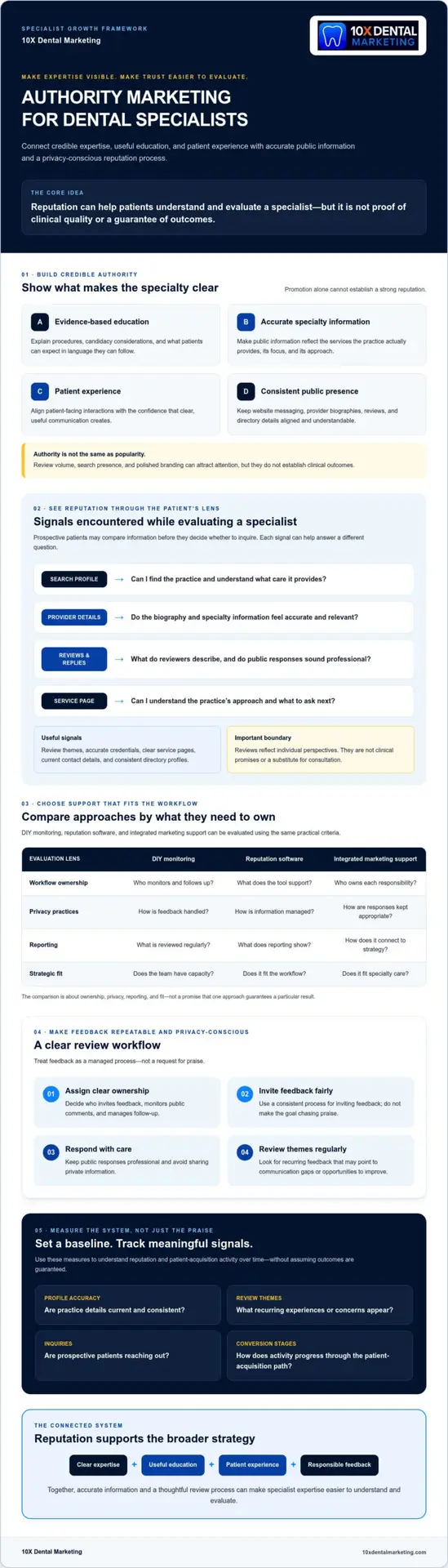
Authority marketing for dental specialists is the coordinated proof of a practice’s expertise, trustworthiness, and ability to provide a relevant patient experience. It connects what a specialist knows with what prospective patients can understand and verify. Promotion alone won’t establish a strong reputation. Communication across educational content, patient interactions, reviews, and public practice information needs to be accurate and consistent.
Prospective patients may evaluate a specialist before making contact. They might compare review comments, read the practice website, check directory details, and notice whether public responses sound attentive and professional. These signals help shape expectations, but they aren’t proof of clinical quality. A high rating or prominent profile can’t replace a qualified clinician’s evaluation or an individualized treatment recommendation.
What does authority marketing mean for a dental specialist?
It means making specialty expertise clear and demonstrable. Explain procedures, candidacy considerations, and what patients can expect in language they can follow. A practice offering full-arch implants, for example, could explain the evaluation and treatment process without suggesting everyone is a candidate. A dental sleep medicine practice might describe how patients are evaluated and what care the practice provides. Content marketing supports this approach by sharing useful information with a defined audience instead of relying on broad claims or visibility alone.
Authority isn’t the same as popularity. Review volume, search presence, and polished branding may attract attention, but they don’t establish clinical outcomes. The goal is alignment: public information should accurately reflect the specialist’s focus, and the patient experience should support the confidence that clear communication creates.
How does reputation shape a patient’s first impression?
Reputation is more than a collection of reviews. It includes the signals a prospective patient encounters: what reviewers describe, how the practice responds, whether the website explains the specialty, and whether directory details are accurate and consistent. If these messages conflict, patients may hesitate or misunderstand what the practice offers. Clear, coherent communication helps them understand what the practice does and what to ask next.
That coordination extends beyond review requests. Teams need a thoughtful way to invite feedback, monitor public comments, respond without sharing private information, and identify recurring concerns that may point to communication gaps. Reviews can inform improvement, but they shouldn’t become a script for clinical promises or a substitute for consultation.
For a wider view of how a specialist’s positioning, message, and patient-facing identity work together, explore dental brand development. Reputation belongs in the strategy when it reinforces a clear, credible brand, not when it operates as an isolated review count.
How Reputation Signals Build Dental Specialist Authority
Reputation can influence decisions at different points in a patient’s path to care. Someone researching a specialist may first encounter a search profile, compare provider biographies, read reviews, and visit a service page before deciding whether to inquire. Each step can answer a different question: Does this practice provide the care I’m seeking? Can I understand its approach? Does its public information feel consistent and current?
Reputation indicators can show what patients and public profiles communicate, but they cannot prove or guarantee clinical outcomes. Reviews describe individual perspectives, not a promise that another patient will have the same experience or result. Keep that distinction clear in every marketing message.
Which reputation signals matter to specialist practices?
Focus on accuracy and relevance, not visibility alone. Review themes may reveal what patients notice about communication or the care experience. Provider biographies should accurately describe credentials and experience. Specialty service pages should explain the services actually provided, and contact details should match across the website, Google Business Profile, and relevant healthcare directories. These profiles can help prospective patients find and evaluate a practice, but their details need regular attention.
Consistency matters. If a profile describes one focus while the website emphasizes another, patients may hesitate or arrive with mistaken expectations. Check that the practice’s specialty, provider information, services, and contact details are clear wherever they appear. These are controllable signals. Whether someone chooses to inquire, how they interpret a review, or what clinical result they experience cannot be guaranteed.
How can expertise become clear without overclaiming?
Make patient education specific enough to be useful and careful enough to be accurate. Explain what a treatment generally involves, factors a clinician may consider when assessing indications, and questions patients can bring to a consultation. A practice offering full-arch implants, for example, can describe the evaluation and treatment process without implying that every patient is a candidate or promising a particular result. Explore full-arch implant marketing for a specialty-specific perspective on communicating this care.
Present credentials and experience precisely. Confirm that titles, training, and service descriptions are current, and avoid language that implies qualifications or outcomes beyond what the practice can substantiate. This is where authority marketing for dental specialists becomes disciplined: educate clearly, align public claims with the care actually offered, and give patients a sound basis for their next question.
For practices assessing how specialty messaging fits a wider patient-acquisition strategy, review the marketing support available for dental specialists.
Compare Dental Reputation Marketing Approaches Before You Commit
Choose a reputation approach based on the work your practice needs done, who will own it, and how it fits your wider marketing strategy. The options aren’t interchangeable. A review platform can organize tasks, but it can’t make sound clinical or communication decisions for your team. Integrated specialist marketing support may connect reputation signals to specialty positioning and patient acquisition, but confirm exactly what the agreement includes.
| Approach | Strategic fit | Workflow ownership | Reporting | Privacy practices | Marketing integration |
|---|---|---|---|---|---|
| In-house monitoring | Flexible; depends on staff expertise | Practice assigns monitoring and response duties | Created and maintained internally | Practice sets access and review procedures | Can align closely if teams coordinate |
| General reputation software | Workflow features may suit broad business needs | Practice configures and oversees use | Check which measures are available and how they’re defined | Review data handling, access, and applicable agreements | May require separate coordination with marketing |
| Integrated specialist marketing support | May align with specialty positioning and patient education | Must be defined in the scope of work | Confirm cadence, metrics, and responsibilities | Ask how data is handled and what safeguards apply | Assess how reputation connects to existing campaigns |
When is an in-house reputation process a practical fit?
Internal management can work when the practice can consistently assign time, train staff, and maintain careful responses. Name an owner for monitoring, profile accuracy, and escalation of sensitive or complex feedback. Document backup coverage so the process doesn’t depend on one person. The right setup depends on your staffing and workload; one process won’t suit every practice.
Depending on its features, software may help organize alerts, tasks, or reporting. It doesn’t replace team judgment, thoughtful communication, or patient care. Before adopting a platform, check what information it handles, who can access it, and whether a data-processing agreement or other safeguard is appropriate. Verify current requirements with qualified privacy or legal guidance.
What should a dental marketing partner be able to explain?
A credible partner should explain how proposed reputation work supports specialty positioning, useful patient education, and defined acquisition goals. Ask who handles each task, how often performance is reported, and what each metric means. “More visibility” isn’t a useful measure unless the provider explains what is tracked and how it relates to qualified inquiries.
Before signing, confirm the service scope, data-handling practices, reporting definitions, contract terms, and coordination with your existing marketing. Ask directly whether reputation work is included or separately scoped. Authority marketing for dental specialists requires strategic fit, clear ownership, and measurable reporting, not assumptions about what a vendor’s package contains.
How to Build a Consistent, Privacy-Conscious Review Workflow
A review process should be consistent, fair, and built around privacy, not designed to manufacture praise. A privacy-conscious review workflow is a repeatable process for inviting feedback, monitoring public channels, responding appropriately, and reviewing themes without promising positive reviews.
Before putting any workflow into practice, verify current HIPAA requirements, FTC guidance, and the rules of each review platform. Guidance can change, and details may depend on how your practice operates. Have the appropriate privacy or legal advisor review procedures when needed. Never use incentives for reviews or selectively ask only patients expected to leave favorable feedback.
How should a practice invite and monitor patient feedback?
Use a neutral request that gives eligible patients a fair opportunity to share an honest experience. Choose a consistent point in the patient journey to make the request. Explain where feedback can be submitted without pressuring anyone to participate or suggesting what they should write.
Assign a staff owner and define a routine for checking the review platforms your practice monitors. Document who handles profile accuracy, who flags sensitive comments, and who serves as backup. Set a schedule your team can maintain across the channels it uses. Track recurring themes internally, such as communication concerns, without copying identifiable patient details into an unnecessary log.
How can specialists respond to reviews responsibly?
Keep public replies brief, professional, and general. A reviewer may disclose personal details, but the practice should not confirm that the person is a patient or discuss treatment, appointments, or other protected information. Avoid arguing point by point or trying to resolve clinical concerns in a public thread.
A neutral response can acknowledge that feedback was received and invite the reviewer to contact the practice through an appropriate private channel. Don’t reveal clinical details there until the practice has followed its established privacy procedures. Escalate clinical, legal, safety, or privacy concerns through the practice’s designated process rather than improvising a public reply.
- Assign ownership: Name the person responsible for monitoring and backup coverage.
- Invite feedback fairly: Use consistent, non-coercive requests.
- Check designated channels: Follow a documented monitoring routine.
- Respond with care: Keep public language general and protect privacy.
- Review themes: Look for service patterns without exposing patient identities.
This discipline supports authority marketing for dental specialists by making public communication more consistent while keeping the focus on patient trust, not review volume. For practices aligning patient feedback with a broader specialty marketing strategy, explore specialist marketing support.
Turn Specialist Reputation Into a Measurable Authority Marketing System
Reputation is more useful when it connects to the rest of your marketing instead of sitting in a report by itself. Align patient-facing messages across brand development, specialty campaigns, educational content, and inquiry tracking. Establish a baseline before making changes. Without one, it’s difficult to assess whether profile updates, review themes, or campaign activity are moving in the right direction.
Which metrics help assess reputation and authority efforts?
Choose measures your team can define and review consistently. A practical scorecard can separate routine activity from patient-acquisition outcomes:
- Reputation and profile activity: Track profile completeness and accuracy, review themes, and response timeliness across the channels you monitor.
- Audience engagement: Review relevant website activity, such as visits to specialty pages and engagement with patient education.
- Inquiry and conversion stages: Where reliable tracking is available, record how inquiries found the practice and whether they progress through defined stages, such as initial contact and consultation scheduling.
Set a baseline, use the same definitions over time, and report on a consistent cadence. Don’t treat more reviews, quicker responses, or increased page visits as proof of business growth. Those are activity or engagement measures. Inquiries and later conversion stages are closer to business outcomes, but attribution still requires care: a patient may encounter reviews alongside referrals, educational content, and other marketing. Correlation alone doesn’t show that reviews caused an inquiry or conversion.
How can 10X Dental Marketing fit into a broader strategy?
10X Dental Marketing offers brand development, full-arch implant marketing campaigns, dental sleep medicine marketing, AI-driven lead generation, and medical billing targeting. These services can be considered as parts of a broader specialist marketing strategy, depending on the practice’s needs. For example, a specialty campaign and clear patient education can reinforce the same positioning patients encounter in a practice’s public profiles.
Confirm the scope before engaging any provider. Ask what work is included, how reporting is defined, how inquiries are tracked, and how proposed activity connects with your existing marketing. Medical billing targeting is one agency capability, but its relevance and scope should be confirmed for each engagement. Don’t assume review monitoring or response management is included as a standalone service, and don’t accept guaranteed results in place of a clear strategy and measurement plan.
Use authority marketing for dental specialists as a system to evaluate: credible positioning, consistent patient-facing information, and reporting that distinguishes activity from outcomes. If you’re assessing how those pieces fit together, assess your specialist marketing strategy.
Make Specialist Authority a System You Can Strengthen
A trusted reputation isn’t built by chasing a higher review count. It grows when specialty expertise, patient-facing information, and feedback practices work together consistently. Pair that foundation with clear measurement, and your team can distinguish routine marketing activity from meaningful patient inquiries without assuming one caused the other.
That’s the value of a disciplined approach to authority marketing for dental specialists: it connects credibility to a broader strategy while keeping public claims accurate and patient privacy in view. The right support should fit your specialty, clarify responsibilities, and explain how progress will be evaluated.
Founded in 2018, 10X Dental Marketing brings leadership experience with nationally recognized Dental Support Organizations. Its services include brand development, specialty marketing campaigns, and AI-driven lead generation. Reputation can inform that wider strategy, but confirm the scope of any proposed work rather than assuming review management is included.
Assess your specialist marketing strategy and identify the next step toward a more credible, measurable presence. Your expertise deserves a clear and consistent story.
Frequently Asked Questions
What is authority marketing for dental specialists?
Authority marketing for dental specialists coordinates credible evidence of expertise, trustworthiness, and a patient experience that fits the specialty. It can include accurate provider information, clear educational content, consistent public profiles, and feedback practices that support patient confidence. The goal isn’t simply to appear more often or collect more reviews. It’s to help prospective patients understand what care the practice provides and what to ask a clinician.
How does reputation management help a dental specialist practice?
Reputation management helps a practice keep public information accurate, understand patient feedback, and respond thoughtfully. These efforts may help prospective patients form an impression as they compare providers, but they can’t guarantee inquiries or establish clinical quality. A useful process can also help the team notice recurring communication concerns and decide whether they call for an internal review or clearer explanations of the practice’s services.
How can a dental practice ask patients for reviews ethically?
Invite eligible patients to share honest feedback through a consistent, neutral process. Don’t pressure people, suggest specific wording, or ask only those expected to leave praise. Avoid offering incentives for reviews, and verify current FTC and platform rules before putting a request process into operation. Assign a team member to oversee the process, use approved communication methods, and make sure requests don’t reveal private patient information.
Can a dental practice respond to a negative review publicly?
Yes, a practice can respond publicly, but the reply should stay brief, professional, and general. Don’t confirm that the reviewer is a patient or mention treatment, appointments, or other private details, even if the reviewer has shared them. Acknowledge the feedback without debating it, then invite the person to contact the practice through an appropriate private channel. Route clinical, legal, safety, or privacy concerns through established procedures.
How should dental specialists measure reputation marketing?
Start with a baseline, then track profile accuracy, review themes, response timeliness, relevant website engagement, and inquiries by source when reliable tracking is available. Define each metric and report on it consistently. Separate activity, such as responses posted, from outcomes, such as inquiries progressing to consultations. Review patterns over time, but don’t assume reviews alone caused a change. Patients may encounter several messages and referral sources before contacting a practice.
Should a dental specialist use reputation software or a marketing agency?
Choose based on the tasks your team needs covered and who will own them. Software may help organize monitoring or reporting, while an agency may connect specialty positioning, campaigns, and patient acquisition if those services are in scope. Ask about responsibilities, data handling, metrics, contract terms, and how the work fits current marketing. Confirm exactly what’s included. Don’t assume an agency offers standalone review management or that software replaces staff judgment.
How do dental specialists build online authority without overclaiming?
Publish clear, accurate education about the services provided, relevant treatment processes, and questions patients can discuss with clinicians. Keep provider biographies and credentials current, and describe experience precisely. Avoid guarantees, unsupported claims, or language implying every patient is a candidate for a procedure. Reviews offer individual perspectives, but they aren’t proof of a likely clinical result. A strong public presence makes expertise understandable while leaving personalized recommendations to clinical consultation.