What if the agency promising growth can’t show you how it plans to earn it? The most costly dental marketing agency red flags often appear in the details: lead quality is unclear, reports stop at clicks and impressions, or nobody can explain who controls your accounts, data, website, and creative.
You’re right to expect more than confident claims. Before you commit budget or access, a credible agency should make its methods, metrics, and accountability clear enough to inspect. This checklist will help you test performance promises, assess reporting and lead handling, clarify asset ownership, and spot contract terms that leave your practice carrying the risk.
You’ll also learn what to ask about procedure experience, campaign strategy, and how targeting connects to measurement. That matters when your goals call for specialized work, such as full-arch implant or dental sleep medicine marketing, rather than a generic pitch. Compare agencies on evidence, process, transparency, and fit, then choose a partner you can hold accountable.
Key Takeaways
- Assess sales claims by looking for observable evidence behind promised outcomes and proprietary methods.
- Spot dental marketing agency red flags by tracing inquiries from their source through contact, consultation, and outcomes recorded by your practice.
- Compare proposals side by side, including scope, reporting, account access, contract term, and exit process.
- Match an agency’s relevant procedure experience to your growth goals, patient journey, and capacity to handle inquiries.
- Follow a clear vetting sequence: define goals, shortlist specialists, verify claims, compare terms, then decide.
Why dental marketing agency red flags matter before you sign
A polished pitch can make growth sound inevitable. It can’t prove the agency has a sound process for reaching the right patients, tracking inquiries, or showing what happened after a campaign launched. Before signing or renewing, assess the work behind the promise. A reliable partner should explain its approach, show relevant evidence, and clarify how results will be measured.
One warning sign may call for a closer look. Several unresolved signs call for a pause. The issue isn’t ambition: an agency can set bold goals while explaining the assumptions and conditions that may affect performance. The concern is a guarantee of patients, revenue, rankings, or return without clear methods and accountability. Marketing outcomes depend on more than an agency’s activity, so examine the claim before you commit.
What counts as a dental marketing agency red flag?
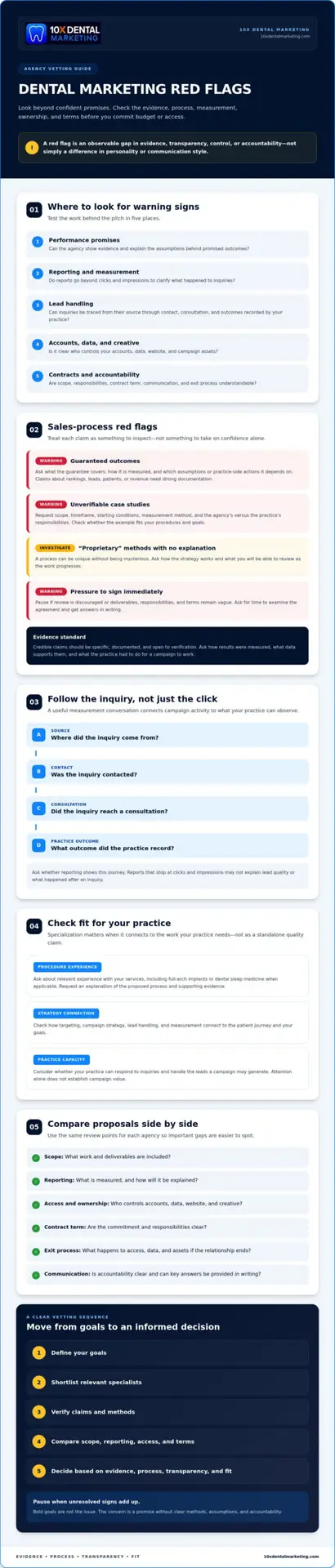
A red flag is an observable gap in evidence, transparency, control, or accountability. For example, an agency cites results you can’t verify, won’t explain what its report measures, or can’t tell you who owns the accounts and campaign assets. These are concrete issues to investigate. A representative’s personality or preferred communication style, on its own, is a subjective preference, not proof of poor work.
Responsible marketing also means distinguishing what’s known from what’s assumed, and being clear about what the agency can control. That standard aligns with ethical marketing principles, including transparency and consideration of stakeholder interests. Ask for specifics, and don’t accept confidence in place of evidence.
Why dental marketing needs more than a polished pitch
Agency fit depends on the practice, not just the proposal. Procedure mix, the patient journey, capacity to respond to inquiries, and lead handling all affect whether a campaign is workable. A plan that generates attention but ignores what happens after an inquiry may leave the practice unable to judge its value.
Full-arch implants and dental sleep medicine call for relevant campaign understanding, but specialization alone doesn’t prove quality. Ask the agency to explain its experience with the procedure, outline the proposed process, and show how targeting, lead handling, and measurement connect. Use the questions ahead to test those claims before a sales pitch becomes a commitment.
Spot these dental marketing agency red flags in the sales process
The sales process is an early stress test. Don’t judge an agency by confidence alone. Notice how it responds when you ask for proof, detail, and time to review. These dental marketing agency red flags are observable behaviors, not simply a matter of whether you like a representative’s style.
- Guaranteed outcomes: Ask what the guarantee covers, how it’s measured, and what assumptions or practice-side actions it depends on. Treat promises of specific rankings, lead volumes, patients, or revenue as claims that need strong documentation.
- Unverifiable case studies: Request the campaign scope, timeframe, starting conditions, measurement method, and agency versus practice responsibilities. Ask whether the example is comparable to your procedures and goals.
- Unexplained proprietary methods: A process can be unique without being mysterious. Ask the agency to explain its strategy and what you’ll be able to review as work progresses.
- Pressure to sign immediately: A proposal that discourages review or leaves deliverables, responsibilities, or terms vague deserves a pause. Ask for time to examine the agreement and get answers in writing.
Promises, case studies, and proof that do not withstand scrutiny
Ask how each result was measured, what data supports it, and whether the agency can substantiate examples it publishes. A case study without context may hide important differences, such as a different service mix, starting point, or level of practice involvement. Request enough detail to understand what the agency did and what the practice had to do for the campaign to work.
Credible claims should be specific, documented, and open to verification. If the agency can’t explain the basis for a bold promise, don’t treat certainty as evidence. For dental-specific context on truthful advertising, review the Colorado Dental Association’s discussion of the ADA Code of Ethics. Ask the agency how it reviews claims before they appear in marketing materials.
Vague strategy and pressure tactics
Ask the agency to explain its plan in plain language: who it aims to reach, what offer or message it will use, which channels are involved, what happens after an inquiry, and how progress will be measured. If the answer is mostly jargon, ask for a concrete example. A specialist should connect relevant procedure experience to a clear campaign process, not rely on the label alone.
For full-arch implant campaigns, compare the agency’s explanation with its full-arch implant marketing strategy. Use it to prompt sharper questions, not as proof of results. Practices assessing a potential fit can also review 10X Dental Marketing’s areas of specialization alongside the agency’s documented process and terms.
Use this checklist to inspect reporting, data, and account ownership
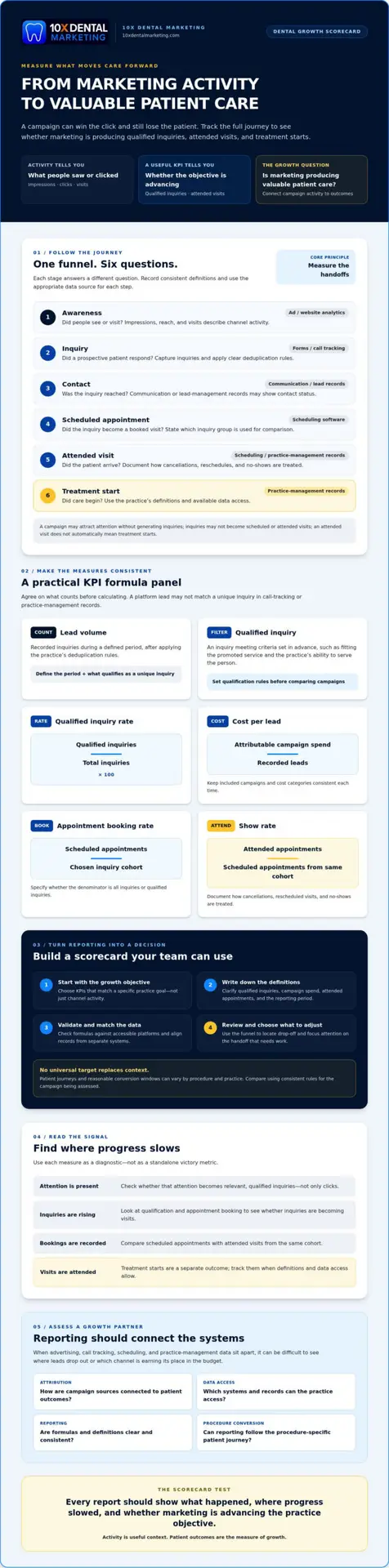
A dashboard full of activity can still leave the practice guessing. Clicks and form fills show interaction, not whether inquiries were suitable, reached, booked for a consultation, or became an outcome recorded by the practice. Use this audit to check whether reporting is traceable and whether your practice can access the assets and information behind it.
- Request a sample report. Ask to see the format you’ll receive, with sensitive information removed. Check whether it separates channels and states the reporting period.
- Get metric definitions. Ask what counts as an inquiry or lead, how duplicates are handled, and whether reported numbers are agency-tracked or confirmed by your practice.
- Trace the journey. Follow an inquiry from its source through contact, consultation, and the outcome recorded by the practice. Ask where each record comes from and where tracking gaps may occur.
- Confirm access. Identify who administers the advertising accounts, analytics, website, tracking tools, and creative files. Check what access your team has and what happens if the relationship ends.
- Set the review rhythm. Agree on meeting cadence, attendees, what decisions the report should support, and how questions or tracking discrepancies will be resolved.
What should a transparent dental marketing report show?
Useful reporting connects channel-level spend and lead counts to clear definitions and a stated date range. It should help your team compare campaign records with its own inquiry and appointment data, while making gaps visible instead of presenting estimates as confirmed outcomes. Useful reporting means traceable metrics, clear sources, and stated limits. If a metric can’t be explained, ask what decision it is meant to inform.
Who controls your accounts, assets, and patient-related data?
Clarify ownership and administration in writing. Ask which party controls each account, who can change settings, and how the practice can retrieve its website materials, creative, and tracking information. For patient-related data, ask what is collected, who can access it, how it is handled, and what happens to it when the engagement ends. Missing access or vague answers are dental marketing agency red flags to investigate, not details to leave until offboarding.
Privacy obligations depend on the information and circumstances involved. Don’t rely on an agency’s general assurance as a legal determination. Have qualified counsel review relevant data practices and agreements, and document the agency’s answers before granting access.
Compare agency contracts, communication, and measurement before committing
Good proposals make comparison possible. Build a simple scorecard for each agency so a persuasive presentation doesn’t overshadow the terms that shape the working relationship. A low fee isn’t proof of poor quality, and a large proposal isn’t proof of value. Compare what you’ll receive, how success will be assessed, and what happens if the fit isn’t right.
Include these rows in your comparison:
- Scope and deliverables: What work is included, what’s excluded, and who is responsible for each task?
- Lead definition and measurement: What counts as a qualified lead, and how will the agency distinguish inquiries from outcomes confirmed by your practice?
- Reporting and communication: How often will you review performance, who will attend, and how will the agency explain campaign changes?
- Access and work product: What accounts, data, and materials can your team access, and what can you retain if the engagement ends?
- Term and exit: How long does the agreement run? What are the renewal, termination, and transition steps?
Use the same questions for every proposal. That gives you a consistent basis for comparing fit, transparency, and accountability, not just presentation quality. Unclear lead definitions or unexplained changes can be dental marketing agency red flags, especially if the agency won’t document its answers.
Questions to ask before signing a dental marketing contract
Request the exact scope, exclusions, responsibilities, review schedule, and reporting cadence in writing. Clarify the contract length, renewal terms, termination steps, and access to work product. If ownership, responsibilities, or other obligations remain unclear, have a qualified professional review the agreement before you sign. A verbal explanation isn’t a substitute for clear contract language.
How to distinguish a fixable gap from a deal-breaker
A missing detail may be fixable if the agency responds directly, provides evidence, and assigns a clear owner to resolve it. Give the agency a chance to answer specific questions, then assess the response, not just the promise to follow up.
Pause if material claims, account access, or data practices remain unresolved after you’ve asked for clarification. Score each agency consistently on evidence, fit, transparency, and accountability. If medical billing targeting is relevant to your goals, review medical billing targeting for dental marketing as one specialized approach to evaluate. Ask how the targeting process works and how its performance would be measured. Don’t assume the service guarantees patient acquisition or treatment acceptance.
To assess whether specialized marketing aligns with your practice’s goals, explore 10X Dental Marketing’s services as one option to compare against your scorecard.
Choose a dental marketing agency that can prove its fit
Make the decision in sequence. Define the practice’s growth goals, shortlist agencies with relevant experience, verify their claims, compare written terms, then decide. A strong fit isn’t the agency with the boldest pitch. It’s the partner that can connect its expertise to your procedures, patient journey, operational capacity, and measurement needs.
A final due-diligence checklist for agency selection
Before signing or renewing, confirm the details that determine whether the partnership can work:
- Experience: Can the agency explain relevant campaign experience and provide examples you can assess?
- Scope: Are deliverables, exclusions, responsibilities, and review schedules clearly documented?
- Reporting and access: Can your team review the reports, accounts, and work product needed to assess performance?
- Data practices: Has the agency explained what information is collected, who can access it, and how it is handled?
- People and process: Who handles strategy, execution, lead follow-up, and routine performance reviews?
- Contract terms: Are the agreement’s term, renewal, termination, and transition steps clear?
Write down every unanswered question and resolve material gaps before committing. Unresolved dental marketing agency red flags aren’t a reason to rush; they’re a reason to pause and ask for clear answers.
When a specialized dental marketing partner may make sense
Specialization may be valuable when an agency can explain how its relevant campaigns work, what the practice needs to contribute, and how progress will be measured. 10X Dental Marketing specializes in full-arch implant and dental sleep medicine marketing, but that doesn’t make it the right choice for every practice. Judge the fit against your goals, capacity, and the agency’s documented process.
If you’re considering AI-driven lead generation, ask what inputs inform the approach, why particular audiences are targeted, what safeguards apply, and how outcomes are measured. Expect a clear explanation, not a promise of patient acquisition or treatment acceptance.
If your practice is evaluating a specialized marketing partner, talk with 10X Dental Marketing about your practice’s growth goals. Bring questions about fit, methods, responsibilities, and expectations. A focused conversation should help you determine whether the approach aligns with what your practice needs.
Choose your next agency partner with confidence
The strongest agency choice isn’t the one with the boldest promise. It’s the one that can show relevant experience, explain its methods, define how performance is measured, and put access, responsibilities, and contract terms in writing. Use this dental marketing agency red flags checklist to verify claims, trace reporting, and resolve unanswered questions before signing or renewing.
Fit matters, too. Match the agency’s expertise to your procedures, patient journey, and capacity to handle inquiries. 10X Dental Marketing specializes in full-arch implant and dental sleep medicine marketing, and offers AI-driven lead generation and medical billing targeting. Founded in 2018, the company has leadership with experience at nationally recognized Dental Support Organizations. These details may be relevant as you evaluate a partner, but your goals and the agency’s documented process should guide the decision.
Want to assess whether that specialization fits your practice? Talk with 10X Dental Marketing about your practice’s growth goals. Ask direct questions, expect clear answers, and choose a partner you can hold accountable. Your next decision can be informed, deliberate, and built around the goals that matter to your practice.
Frequently Asked Questions
How can I tell if a dental marketing agency is trustworthy?
A trustworthy agency gives specific, verifiable answers about strategy, deliverables, reporting, account access, and data handling. Ask for case studies that explain campaign scope, timeframe, starting conditions, and how results were measured, rather than just impressive outcome claims. The agency should define success, explain limitations, and clarify what your team needs to do. Before committing, compare the written proposal with the sales presentation and resolve any differences.
What are the biggest red flags when hiring a dental marketing agency?
Watch for guaranteed results without clear evidence, vague deliverables, pressure to sign immediately, inaccessible advertising accounts, unclear reporting, or evasive answers about data practices. One concern may be fixable if the agency responds with specifics and documents its answer. Several unresolved dental marketing agency red flags, especially around claims, ownership, or accountability, call for a pause. Request clarification in writing before you agree to the proposed terms.
What should a dental marketing agency report each month?
Ask for a report that states the period covered, channels, spend, inquiry volume, and how leads are counted. Where your practice systems allow, compare campaign records with contact, appointment, and outcome data recorded by the practice. The report should explain meaningful campaign changes and identify measurement limits. Clicks and form submissions show activity, but they don’t establish whether inquiries were suitable or became patients.
Can I leave a dental marketing agency and keep my accounts?
That depends on the contract, account setup, and ownership terms. Before signing, clarify who administers advertising and analytics accounts, the website, creative materials, and tracking assets. Ask how your team can access or retrieve each item if the engagement ends, and get the relevant terms in writing. If the agreement doesn’t clearly address ownership or exit steps, seek professional review before you commit.
Should a dental marketing agency guarantee leads or revenue?
Treat guarantees of leads, rankings, or revenue as claims to examine, not automatic proof of misconduct. Ask what exactly is guaranteed, how it’s defined, what assumptions apply, and what evidence supports it. Outcomes can depend on factors beyond marketing, including practice capacity and follow-up. Don’t rely on a promise without clear written terms and substantiation, or without understanding what the agency can and can’t control.
What questions should I ask a dental marketing agency before signing?
Ask what work is included, who performs it, how results are measured, and who controls accounts and campaign assets. Clarify how data is handled and what happens at renewal or exit. Request relevant case-study context and a sample report, then ask what your team must contribute, including lead follow-up. Finally, ask which outcomes the agency can’t promise and make sure its answers align with the written agreement.